Leave A Message
If you are interested in our products and want to know more details,please leave a message here,we will reply you as soon as we can.

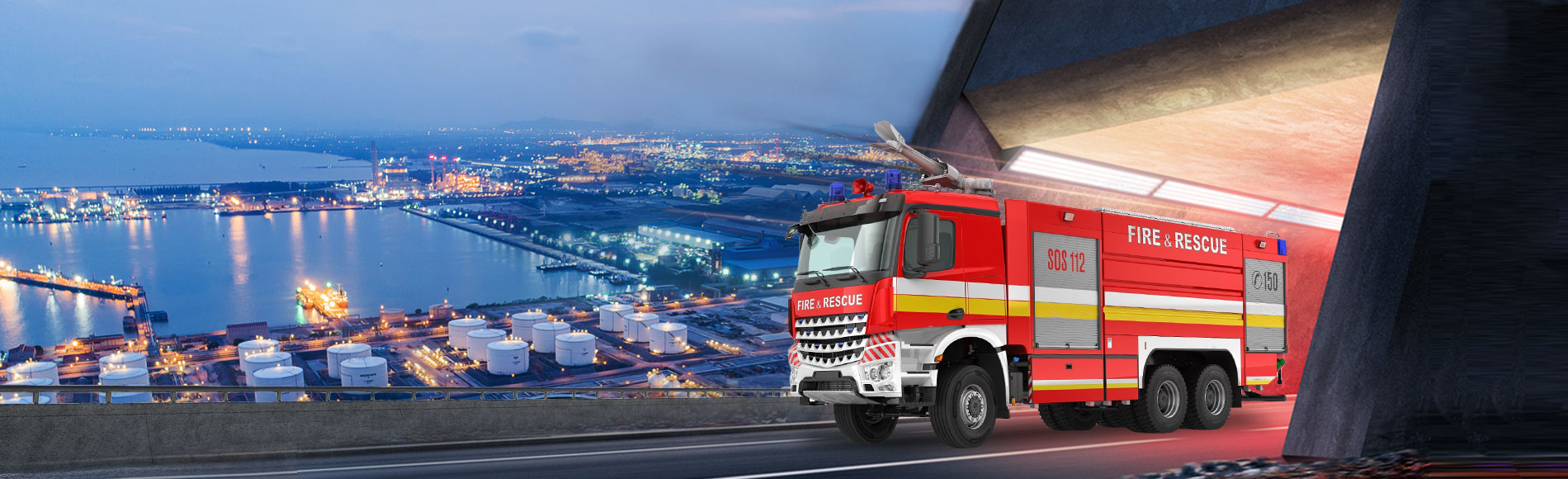
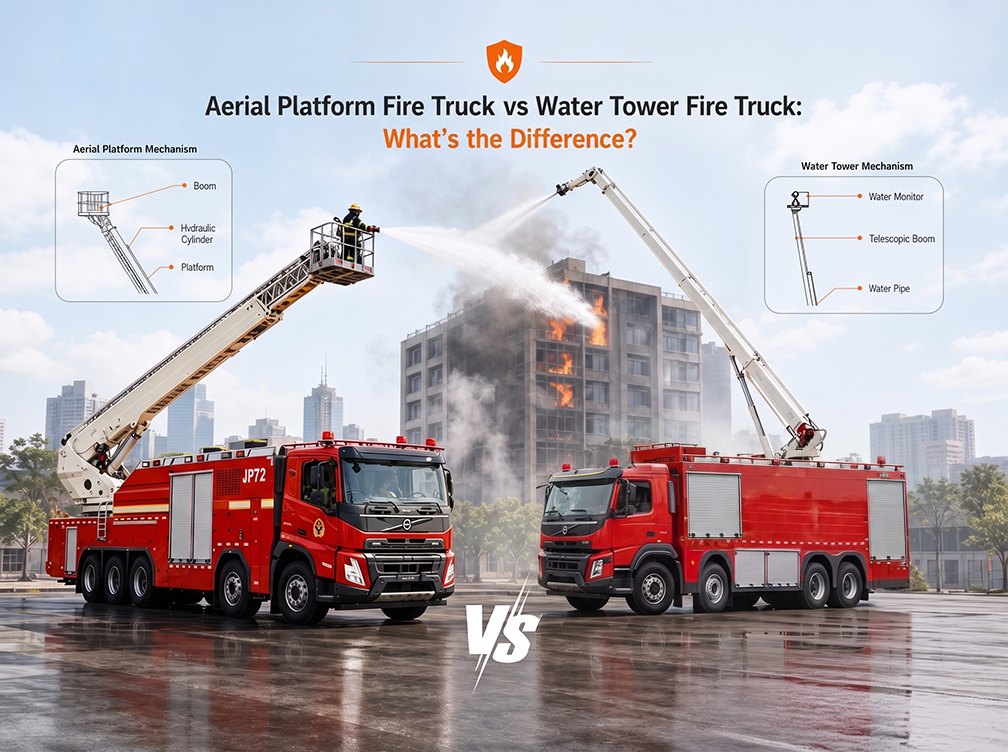
Aerial Platform Fire Truck vs Water Tower Fire Truck: What's the Difference?
When it comes to fighting fires in high-rise buildings, industrial facilities, or large warehouses, aerial fire trucks are indispensable. But among the various types of aerial apparatus, two often cause confusion: the aerial platform fire truck and the water tower fire truck. While they may look similar at first glance—both feature hydraulic booms and are designed for elevated firefighting—they serve fundamentally different missions.
This article breaks down the key differences between these two vehicle types, helping fire service professionals, procurement managers, and equipment distributors make informed decisions based on operational needs.
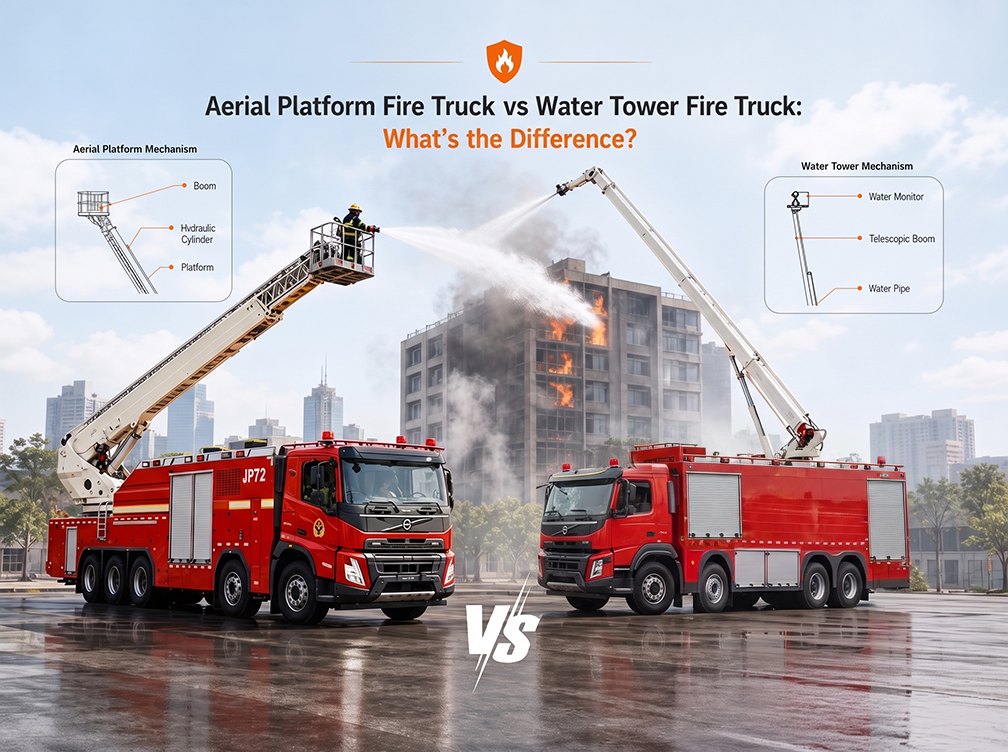
According to the Chinese national standard GB 7956.12-2015, both vehicles fall under the category of aerial fire fighting vehicles—vehicles equipped with elevating booms, turntables, and firefighting equipment for high-altitude operations. However, their specific definitions highlight a critical distinction.
An aerial platform fire truck is equipped with a folding or folding-telescopic combination boom, a personnel platform, a turntable, and firefighting devices. The defining feature is the work platform (bucket) at the end of the boom, where firefighters can stand to perform rescue and firefighting operations.
Key characteristics:
• Equipped with a platform that can carry 750 lbs to over 1,500 lbs of personnel and equipment
• Designed for both rescue and firefighting—firefighters can operate directly from the platform
• Platform can be used with descent control devices, hydraulic winches, or rescue chutes
• Broader horizontal reach and greater working span compared to water towers
A water tower fire truck is equipped with a folding or folding-telescopic combination boom, a turntable, and firefighting devices—without a personnel platform. Instead, a fire monitor (water cannon) is mounted at the boom tip, which can be remotely controlled from the ground.
Key characteristics:
• No personnel platform—firefighters operate from the ground via remote control
• Focused exclusively on elevated fire suppression, not rescue
• Delivers exceptionally high water flow—exceeding 2,000 gallons per minute on many industrial models
• Designed for industrial fire protection where rescue capability is not required
| Feature | Aerial Platform Fire Truck | Water Tower Fire Truck |
|---|---|---|
| Primary Function | Rescue + firefighting | Firefighting only |
| Boom Tip Equipment | Work platform (bucket) for personnel | Fire monitor (water cannon) |
| Personnel on Boom | Yes—firefighters can operate from platform | No—operated from ground via remote control |
| Rescue Capability | High—can evacuate trapped persons | None |
| Water Flow Capacity | Up to 1,500+ GPM | 2,000+ GPM (industrial models) |
| Typical Operating Height | 50–130 feet | 50–130 feet |
| Platform/Bucket Capacity | 750–1,500+ lbs | Not applicable |
| Weight | Heavier (e.g., 36 tons for 54m model) | Relatively lighter |
| Best Suited For | Urban high-rise rescue, multi-purpose departments | Industrial sites, large-scale fire suppression |
The aerial platform fire truck is the ultimate multi-purpose aerial apparatus—it handles both firefighting and rescue in a single vehicle. The work platform provides a stable, secure working environment at height, significantly reducing the hazards associated with climbing ground ladders.
Best suited for:
• Urban high-rise rescue operations—evacuating trapped residents from upper floors
• Fire departments that need one vehicle for multiple functions—the platform can be used for ventilation, rescue, and firefighting
• Scenarios requiring personnel to work directly at the elevated fire scene—such as breaching windows, conducting search operations, or directing fire streams precisely
Advantages:
• Higher personnel and equipment carrying capacity
• Broader functional versatility for mixed-response departments
• Platform can be fitted with additional tools (nozzles, thermal cameras, rescue equipment)
Disadvantages:
• Heavier and more expensive than comparable water towers
• Greater maintenance requirements due to more complex construction
• Longer setup time than water towers for pure firefighting missions
Water tower fire trucks are specialized for sustained, high-volume elevated fire suppression where rescue capability is not required. The absence of a personnel platform allows for a simpler design, lower cost, and—critically—higher water flow capacity without the weight and complexity of a rescue platform.
Best suited for:
• Industrial fire protection—oil tank farms, chemical plants, large warehouses
• Fire departments with separate rescue vehicles—using water towers exclusively for fire flow
• Locations with large building footprints requiring extreme water flow from elevated positions
• Budget-conscious departments where rescue capability is already covered by other apparatus
Advantages:
• Higher water flow capacity (2,000+ GPM) on many models
• Lower cost and simpler maintenance than platform equivalents
• Slightly lighter and easier to position for pure suppression operations
Disadvantages:
• No rescue capability—cannot evacuate trapped persons
• Firefighters must operate from the ground via remote control, reducing hands-on flexibility
• Must rely on other vehicles for rescue operations
Both vehicle types are available in operating heights ranging from approximately 50 feet to over 130 feet. However, aerial platforms typically offer greater working span—the ability to reach horizontally across obstacles—due to the flexibility of their articulating booms.
Water towers, while generally simpler, may feature large-span multi-section booms (like the 6-section folding boom on certain models) that can extend up to 58 meters forward and 62 meters upward, with downward extension capability of 45 meters.
Aerial platform trucks are significantly heavier due to the reinforced boom and platform structure. For example, a 54-meter aerial platform truck can weigh 36 tons, while a comparable water tower of the same height may be lighter. This weight difference affects:
• Bridge and road load limits—heavier vehicles may be restricted on certain routes
• Jack spread—larger apparatus require more space to stabilize (typically 18 feet or more)
• Fuel consumption and operating costs
For pure fire suppression, water towers generally deploy faster than aerial platforms. An 80-meter-class aerial platform can require 200+ seconds of theoretical setup time, with actual preparation (site survey, jack stabilization, water supply connection) often taking 5 to 10 minutes in real-world conditions. Water towers, with their simpler booms and no platform, can often be deployed more quickly.
This is where water towers truly excel. Industrial-grade water towers can deliver water flows exceeding 2,000 gallons per minute—far beyond the 1,500 GPM typically available from aerial platform monitors. This makes water towers the preferred choice for facilities where large-volume fire suppression is the highest priority.
| Flow Rate Comparison | Aerial Platform | Water Tower |
|---|---|---|
| Typical Maximum Flow | 1,500+ GPM | 2,000+ GPM |
| Key Priority | Personnel rescue + moderate flow | Maximum flow for suppression |
Both vehicle types incorporate significant safety features. However, platform aerials offer an important safety advantage for personnel: firefighters operating from a platform are continuously protected by fall protection systems, minimizing the risk of falling from height.
Water towers, by contrast, keep all personnel on the ground—eliminating fall risks entirely. This is a significant advantage in hazardous situations, as seen in the 1998 Tempe, Arizona, arson fire, where a firefighter on a straight ladder tip was nearly killed by a fireball; subsequent safety reviews led many departments to switch exclusively to aerial platforms for personnel safety.
During the 2026 "Su Chao" football event in Xuzhou, a DG101 aerial platform fire truck (101-meter working height, 27-meter working span, 400kg platform capacity) was deployed at the Xuzhou Olympic Sports Center for rescue and surveillance duty. The vehicle's 360-degree rotation, 4800 L/min fire system, and fast deployment (96 seconds setup) made it ideal for crowd protection and event coverage.
During the 2015 Beijing Dahongmen lumber yard fire, a 44-meter water tower from an international brand was deployed. When its telescopic boom proved unable to reach over obstacles, a 48-meter water tower with a 6-section folding boom was called in. It extended over the obstacles, brought the water outlet directly to the fire source, and successfully controlled the fire over 4 hours. This case highlights the horizontal reach superiority of modern water towers with articulating booms.
When deciding between these two vehicle types, consider the following:
| Factor | Aerial Platform | Water Tower |
|---|---|---|
| Department's Rescue Capacity | Can serve as the primary rescue vehicle | Requires separate rescue apparatus |
| Building Height | Both cover similar heights (50–130+ ft) | Both cover similar heights |
| Industrial vs. Urban | Urban mixed-use departments | Industrial/warehouse-heavy departments |
| Water Flow Needs | Moderate flow (1,500+ GPM) | High flow (2,000+ GPM) |
| Budget | Higher cost | Lower cost |
| Maintenance | More complex | Simpler |
| Space Requirements | Larger jack spread, heavier | Slightly lighter footprint |
1. Can a water tower truck rescue people from upper floors?
No. Water tower trucks are designed exclusively for elevated fire suppression and do not have a personnel platform. If rescue is needed, the department must have separate apparatus with rescue capability.
2. Which vehicle is better for a mixed urban/industrial department?
An aerial platform fire truck offers greater versatility, allowing the same vehicle to handle both high-rise rescue and elevated firefighting.
3. How high can these trucks reach?
Both types are available in operating heights from 50 feet to over 130 feet, with some high-end models reaching over 100 meters.
4. What is the cost difference?
Water tower trucks are generally less expensive than aerial platforms of comparable height. The platform's additional structure, reinforcement, and control systems add significant cost.
5. Why choose a water tower over an aerial platform?
If your department already has separate rescue vehicles, if you require maximum water flow (2,000+ GPM), or if your primary responsibility is industrial fire protection, a water tower may be the most cost-effective choice.
Both the aerial platform fire truck and the water tower fire truck are essential aerial apparatus, but they serve distinct missions:
Aerial Platform Fire Truck: Designed for versatility—it handles both elevated rescue AND elevated fire suppression. Choose this if your department needs a multi-purpose vehicle for urban high-rise operations where evacuating trapped persons is a frequent requirement.
Water Tower Fire Truck: A specialist for high-volume, elevated fire suppression where rescue capability is not needed. Choose this if your primary responsibility is industrial fire protection, you need maximum water flow (2,000+ GPM), and you have other vehicles for rescue operations.


You may be interested in the following information
When it comes to fighting fires in high-rise buildings, industrial facilities, or large warehouses, aerial fire trucks are indispensable. But among the various types of aerial apparatus, two often cause confusion: the aerial platform fire truck and the water tower fire truck. While they may look similar at first glance—both feature hydraulic booms and are designed for elevated firefighting—they serve fundamentally different missions. This article breaks down the key differences between these two vehicle types, helping fire service professionals, procurement managers, and equipment distributors make informed decisions based on operational needs. I. What Are Aerial Platform and Water Tower Fire Trucks? According to the Chinese national standard GB 7956.12-2015, both vehicles fall under the category of aerial fire fighting vehicles—vehicles equipped with elevating booms, turntables, and firefighting equipment for high-altitude operations. However, their specific definitions highlight a critical distinction. Aerial Platform Fire Truck An aerial platform fire truck is equipped with a folding or folding-telescopic combination boom, a personnel platform, a turntable, and firefighting devices. The defining feature is the work platform (bucket) at the end of the boom, where firefighters can stand to perform rescue and firefighting operations. Key characteristics:• Equipped with a platform that can carry 750 lbs to over 1,500 lbs of personnel and equipment• Designed for both rescue and firefighting—firefighters can operate directly from the platform• Platform can be used with descent control devices, hydraulic winches, or rescue chutes• Broader horizontal reach and greater working span compared to water towers Water Tower Fire Truck A water tower fire truck is equipped with a folding or folding-telescopic combination boom, a turntable, and firefighting devices—without a personnel platform. Instead, a fire monitor (water cannon) is mounted at the boom tip, which can be remotely controlled from the ground. Key characteristics:• No personnel platform—firefighters operate from the ground via remote control• Focused exclusively on elevated fire suppression, not rescue• Delivers exceptionally high water flow—exceeding 2,000 gallons per minute on many industrial models• Designed for industrial fire protection where rescue capability is not required II. Side-by-Side Comparison Feature Aerial Platform Fire Truck Water Tower Fire Truck Primary Function Rescue + firefighting Firefighting only Boom Tip Equipment Work platform (bucket) for personnel Fire monitor (water cannon) Personnel on Boom Yes—firefighters can operate from platform No—operated from ground via remote control Rescue Capability High—can evacuate trapped persons None Water Flow Capacity Up to 1,500+ GPM 2,000+ GPM (industrial mod...
Details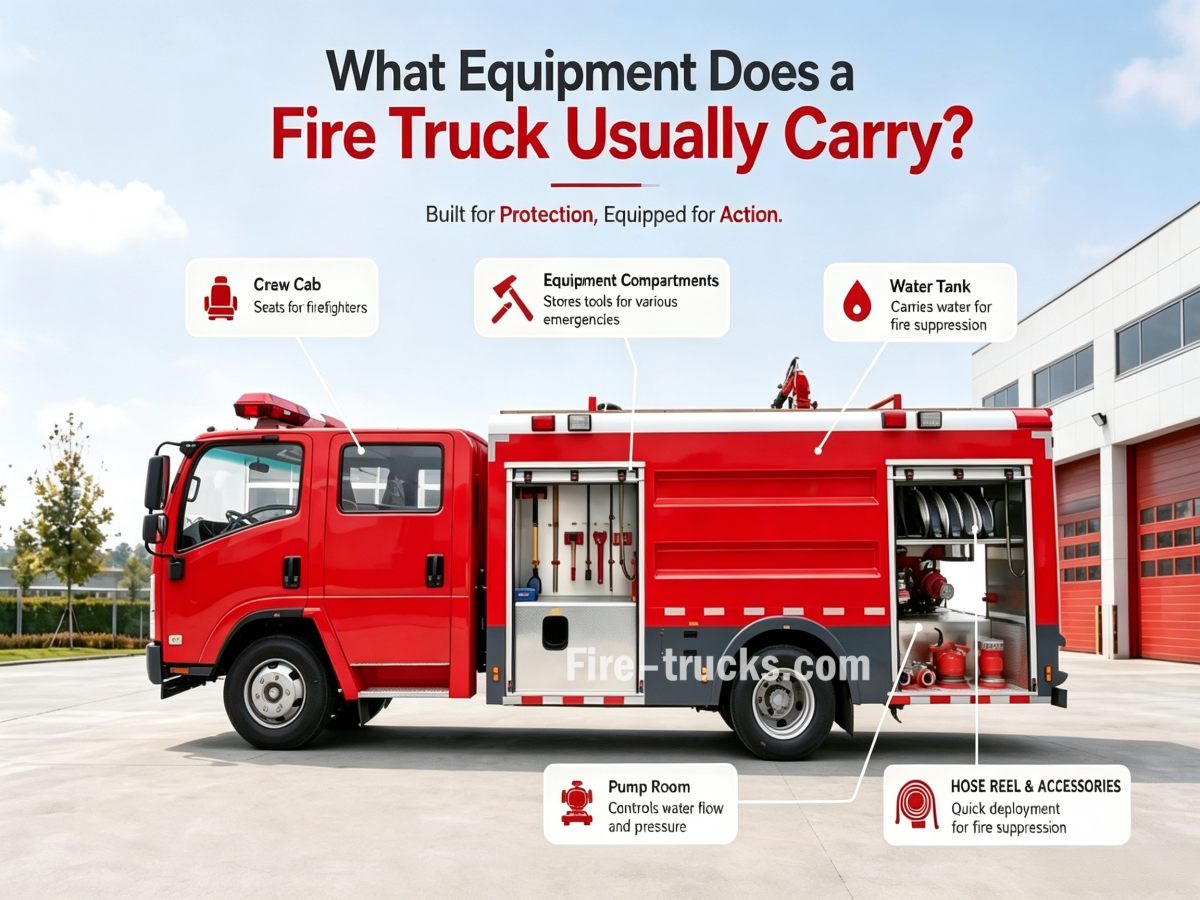
A fire truck typically carries firefighting, water supply, rescue, and safety protection equipment. Common equipment includes fire pumps, water tanks, fire hoses, fire nozzles, fire monitors, valves, fire ladders, rescue tools, protective gear, and communication devices. This article systematically breaks down the classification, functions, and selection considerations of standard fire truck equipment, helping procurement professionals and end-users build a complete understanding of fire apparatus configurations. I. Classification of Fire Truck Equipment 1. Firefighting Equipment — Core tools for direct fire suppression, including fire nozzles, fire monitors, fire hoses, water dividers, and adapters. 2. Rescue and Breaching Equipment — Tools for creating access routes for rescue and firefighting operations, including hydraulic rescue tools, fire axes, pry bars, crowbars, cut-off saws, and chain saws. 3. Rescue and Life-Saving Equipment — Equipment for search, transfer, and protection of personnel, including stretchers, rescue ropes, safety hooks, descent control devices, self-contained breathing apparatus (SCBA), and spare air cylinders. 4. Smoke Exhaust and Lighting Equipment — Equipment for improving fireground conditions, including smoke ejectors, mobile lighting towers, and portable high-intensity searchlights. 5. Personal Protective Equipment (PPE) — Gear to protect firefighter safety, including helmets, structural firefighting protective clothing, gloves, boots, and safety belts. 6. Communication and Reconnaissance Equipment — Equipment for fireground information gathering and command coordination, including two-way radios, thermal imaging cameras, and toxic gas detectors. II. Firefighting Equipment on Fire Trucks 1. Fire Pump The fire pump is the power source for all firefighting operations. It mechanically pressurizes water, giving it sufficient kinetic energy to complete the full process of "drafting → pressurizing → delivering → discharging." Typical fire pump specifications: • Standard Pressure Fire Pump (CB10/30 type): Flow rate ≥30L/s, rated pressure 1.0MPa, rear-mounted installation. Suitable for standard water tenders and foam fire trucks, meeting most urban and industrial firefighting water supply requirements. • Medium/High-Pressure Fire Pump: Low-pressure flow 30L/s at 1.0MPa, high-pressure flow 20L/s at 2.0MPa, rear-mounted installation. The dual-pressure design supports both high-volume supply (low pressure) and long-distance/high-rise delivery (high pressure) in a single pump. Ideal for urban main battle fire trucks and high-rise firefighting scenarios. • High-Pressure Fire Pump: Flow rate 10-15L/s, pressure up to 4.0MPa or higher, rear-mounted or midship-mounted. Used in high-pressure water mist systems, commonly found on airport fire trucks and specialized industrial vehicles. Complete water syste...
Details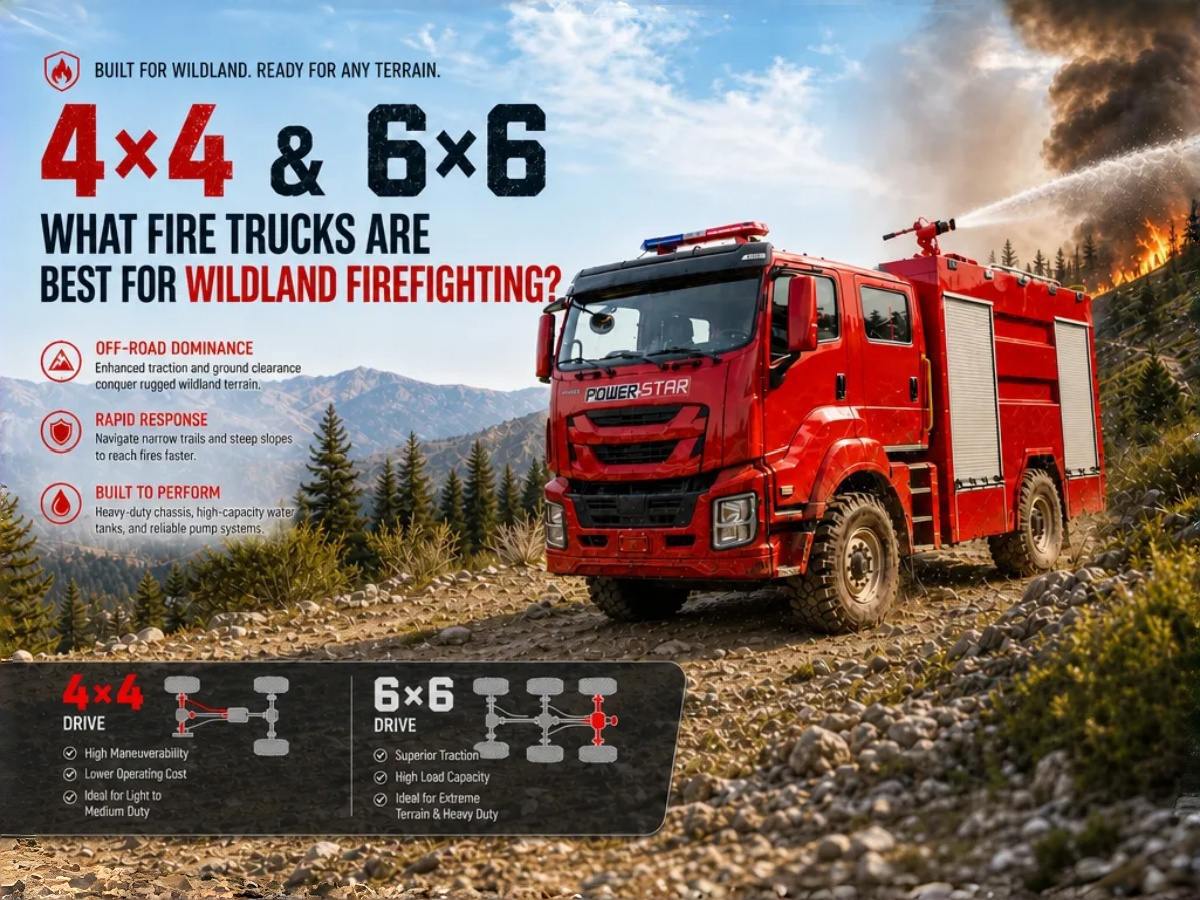
Wildland firefighting presents challenges that are fundamentally different from structural firefighting. In remote forests, grasslands, and mountainous terrain, fire trucks must navigate narrow trails, climb steep slopes, and operate far from hydrants or water sources. Choosing the right fire fighting truck is a strategic decision that directly impacts response time, crew safety, and fire suppression effectiveness. This article provides a comprehensive breakdown of the most suitable fire truck types for wildland firefighting, their core features, and selection methods, helping you make the right decision based on your specific operational requirements. Quick Answer Wildland fires are characterized by large fire areas, complex terrain, limited water sources, and poor road conditions, so there is no single fire truck that can handle all forest fire scenarios. Generally speaking, wildland firefighting primarily uses the following types of fire trucks: • Light wildland fire trucks: for forest road access and rapid response• 4×4 off-road wildland fire trucks: for mountainous and hilly terrain• 6×6 wildland fire trucks: for large-scale forest fires and extended operations• Water tankers: for continuous water supply and support• Foam fire trucks: for oil facilities, forest equipment, or special fires• Rescue vehicles: for communication, lighting, breaching, and logistics support I. Why Do Wildland Fires Require Specialized Fire Trucks? Wildland fires differ fundamentally from structural fires in several critical ways: Key characteristics of wildland fires:• Large fire areas covering hectares of land• Rapidly changing wind directions• Complex and rugged terrain• Limited or no access to hydrants or water sources• Narrow, unpaved forest roads• Difficult communication conditions Standard urban fire trucks are generally unsuitable for wildland firefighting for the following reasons: • Lack 4×4 or all-wheel drive for unpaved mountain roads and steep slopes;• Larger size and low ground clearance make them prone to getting stuck on narrow forest trails and soft terrain;• Urban pumps prioritize high flow at moderate pressure, while wildland operations require high pressure over long hose lays with limited water—a fundamentally different approach. II. Common Types of Wildland Fire Trucks Fire Truck Type Key Characteristics Applicable Scenarios Light Wildland Fire Truck High mobility, compact size Forest patrol, initial attack 4x4 Wildland Fire Truck Strong off-road capability Mountainous and hilly terrain 6x6 Wildland Fire Truck Large water capacity, long endurance Large-scale forest fires Water Tanker Continuous water supply Logistics support, water relay Foam Fire Truck Special fire suppression Forest oil depots, equipment areas Rescue Vehicle Equipment transport Comprehensive rescue operations III. What Key Performance Features...
Details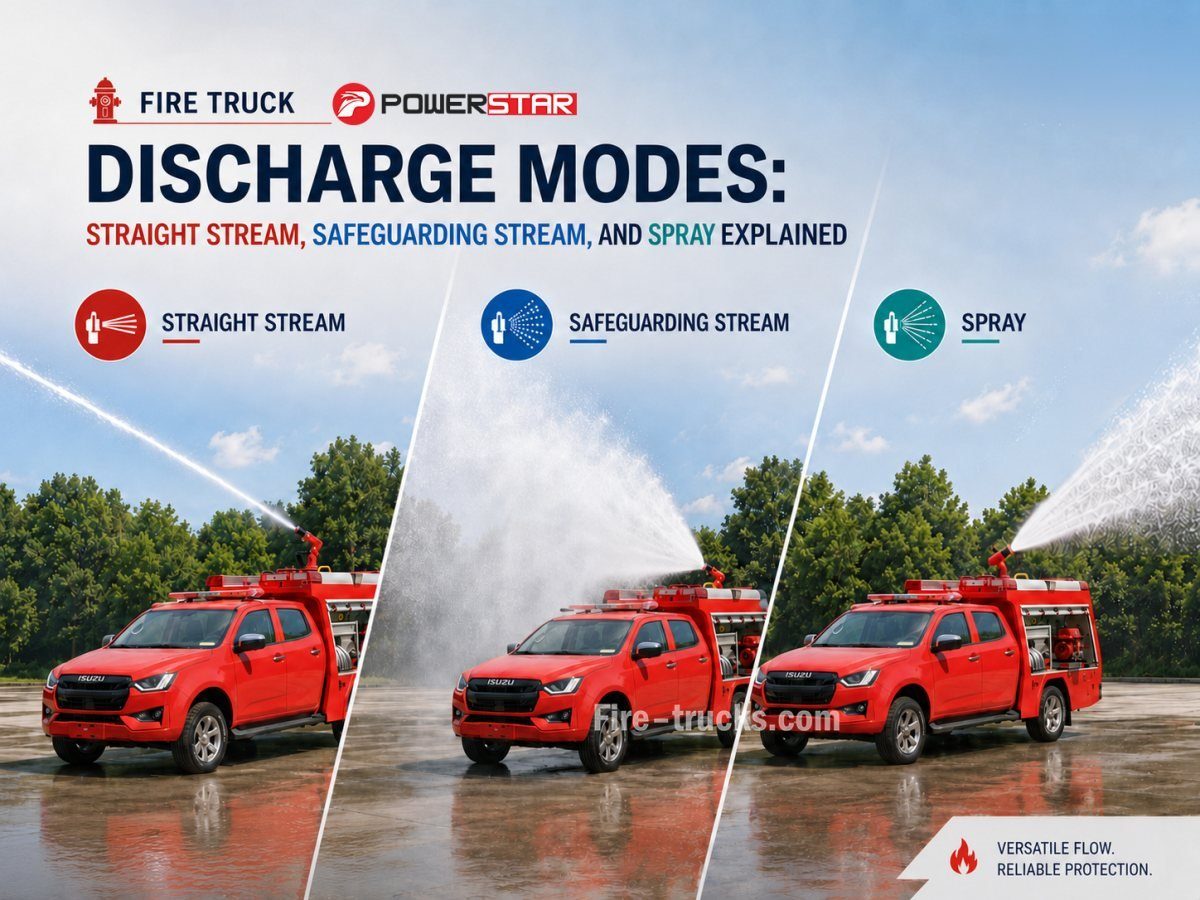
In firefighting operations, the selection of discharge mode directly determines fire extinguishing efficiency, operational safety, and fire control effectiveness. Most people are unaware that fire truck nozzles can switch among three core discharge modes: straight stream, spray stream, and safeguarding stream. Different modes vary significantly in flow pattern, range, impact force, and coverage area, and each corresponds to completely different applicable fire scenarios. This article, based on professional firefighting operation standards, comprehensively analyzes the principles, key characteristics, and applicable scenarios of the three discharge modes, helping our customers systematically master fire truck discharge techniques. I. Why Do Fire Trucks Need Different Discharge Modes? Straight stream, spray stream, and safeguarding stream correspond to three different fire extinguishing mechanisms: impact extinguishing, vaporization suffocation, and thermal radiation protection. Firefighters must flexibly switch according to site conditions. So, why can't we keep using just one type of stream? 1. Diversity of fire types requires different extinguishing media forms Different fire types have different combustion characteristics, which determine the appropriate extinguishing method: • Class A solid material fires require straight stream impact to break up burning materials and penetrate for internal cooling; • Class B liquid fires cannot use straight stream impact (which causes splashing and spreads the fire), but should use safeguarding or spray stream for covering and dilution; • Class E energized electrical fires can only use spray stream, as fine water droplets do not form a continuous conductive path; • Enclosed space fires require spray stream to fill the entire space, achieving extinguishment through vaporization heat absorption and suffocation. No single mode can adapt to all fire types. 2. Different stages of the same fire require different tactical approaches Even for the same fire, different stages require different discharge modes: • In the initial stage when the fire is intense, straight stream is needed for long-range impact on the fire point for rapid suppression; • During advancement, safeguarding stream is needed to form a water curtain barrier to block thermal radiation and protect personnel; • Before entering a room, spray stream is needed to cool and dilute smoke and gases, creating conditions for interior attack. A single mode cannot cover the operational needs throughout the entire firefighting process. 3. Range, coverage area, and cooling efficiency cannot be achieved simultaneously The three modes each have their own advantages and disadvantages in three key dimensions: • Straight stream has the longest range (up to 120m+), but small coverage area, only point-shaped; • Spray stream fills the space and has the highest vaporization heat absorption efficiency, but the shortest rang...
Details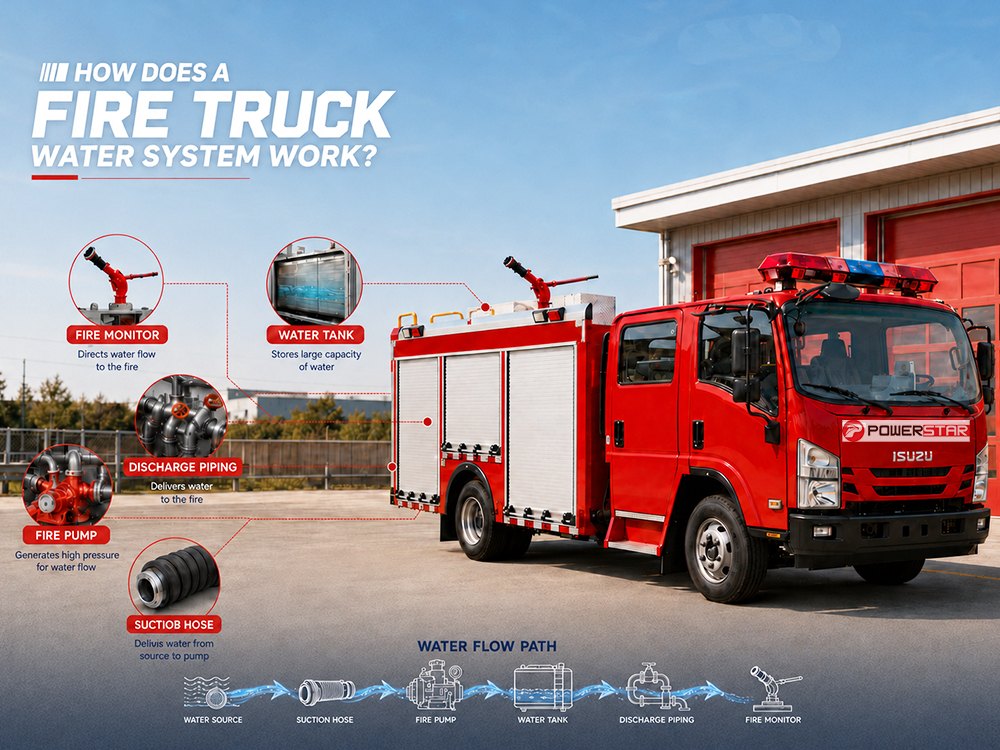
The fire truck water plumbing system is the core of every firefighting operation. It precisely directs water from the tank or an external source through the pump, valves, and piping to deliver high-pressure water or foam to the fire scene — whether it is a high-rise building fire in a dense city center or a petrochemical storage tank fire in an industrial zone. The fire truck water plumbing system consists of multiple components working together: fire pump, water tank, suction hose, discharge piping, valves, dividing breaching, collecting breaching, strainer, fire monitor, hose couplings, and more. The complete flow path is: Water Tank → Suction Hose → Strainer → Fire Pump → Pressure Regulation System → Discharge Manifold → Valves → Dividing Breaching → Fire Monitor / Hose Couplings → Nozzle This article explains each component of the water plumbing system and how they work together to deliver water at the right pressure and flow. I. Core Components of the Water Plumbing System Water Tank Stores onboard water supply. ● Capacity: Typically 2,000–12,000 liters. ● Delivery: Feeds the pump through intake piping. ● Features: Anti-slosh baffles for vehicle stability, strainer to filter debris, and priming system for drafting from natural water sources. Fire Pump A centrifugal pump driven by the truck engine through PTO; single/multi-stage, cast iron or bronze. ● Pressure grades: Available in standard ratings of 0.8 MPa, 1.0 MPa, 1.2 MPa, and 1.4 MPa, matching typical firefighting requirements. ● Flow rates: Ranges from 1,200 to 6,000 L/min, with performance curves optimized for both high-pressure and high-volume operations. Valves and Piping A network of pipes and valves that controls the direction and volume of water flow. ● Intake valve: Connects the pump to external water sources (hydrant or drafting point) ● Tank-to-pump valve: Allows the pump to draw water directly from the onboard tank ● Discharge valves: Control water flow to hoses and nozzles II. How the Fire Truck Water Plumbing System Works Step 1: Water Intake and Priming Water enters the system from the onboard tank, fire hydrant, or natural water sources (lakes, rivers, ponds). When drafting from natural sources, the priming system (vacuum pump) removes air from the suction hose, creating a vacuum that allows atmospheric pressure to push water into the pump. A strainer filters debris to protect the pump, and a check valve prevents backflow. Step 2: Pump Pressurization The centrifugal pump is driven by the truck engine through a power take-off (PTO). Once water fills the pump, the impeller spins at high speed (1,500–2,500 RPM). Centrifugal force throws water outward, increasing its velocity. The pump casing converts this velocity into pressure (typically 0.8–1.2 MPa). An electronic pressure governor automatically maintains the set pressure, while a relief valve prevents over-press...
Details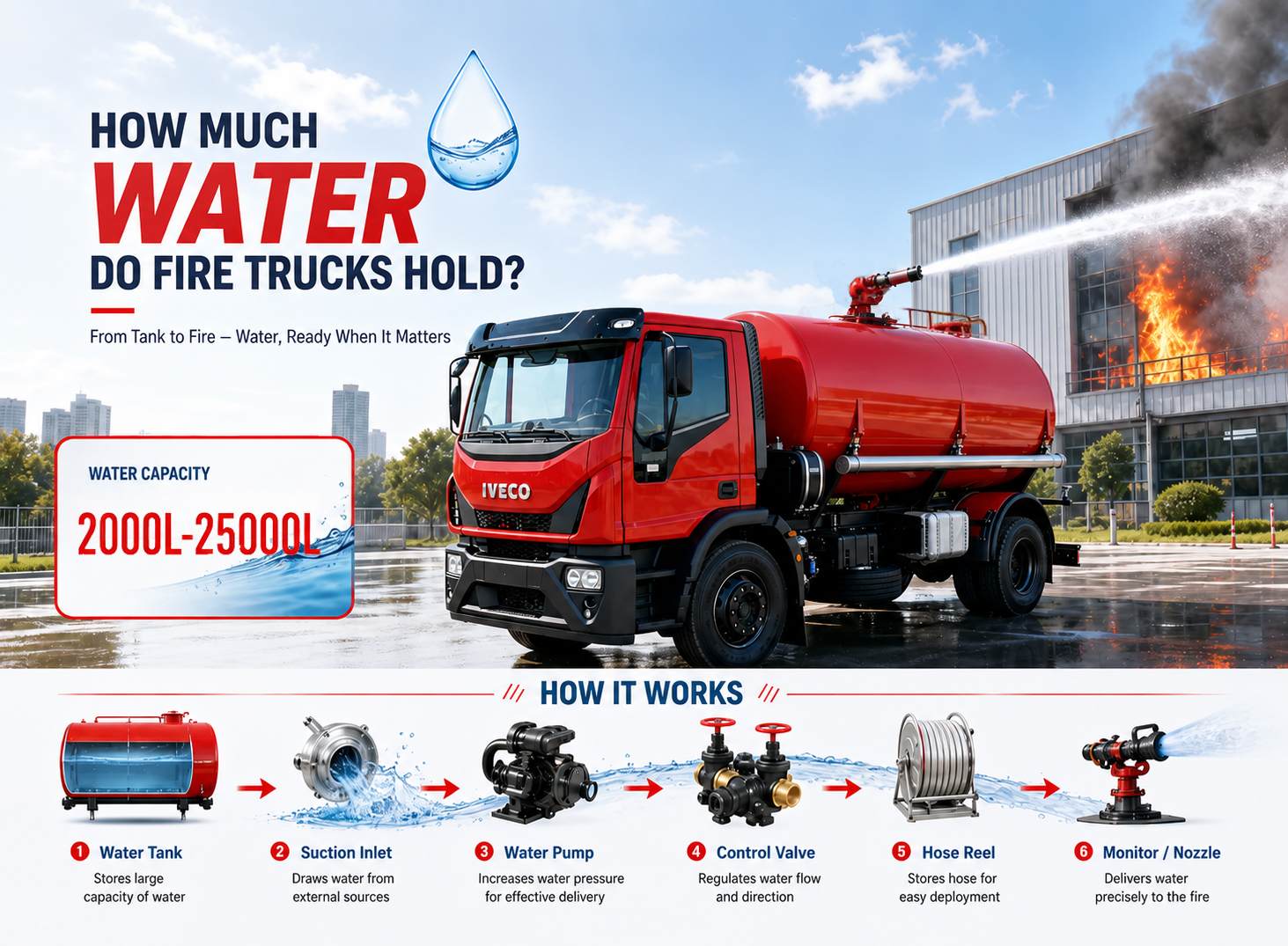
How much water can a fire truck carry? This is one of the first questions our customers face when selecting a fire truck. There is no single fixed number — it depends on vehicle type, chassis capacity, design purpose, and regional regulations, ranging from 2,000 liters light-duty units to 25,000 liters industrial fire trucks. But a larger tank does not always mean better performance; fire fighting vehicle water tank capacity must be properly matched with pump flow rate, monitor discharge rate, and chassis capacity to deliver effective firefighting results. This article starts with the fundamentals of fire truck water tank capacity, analyzes typical storage ranges for different vehicle types, examines the key factors that influence tank design, and provides practical purchasing guidance. Key Takeaways: Fire truck water tank capacity typically ranges from 2,000 to 25,000 liters Different fire truck types have different tank capacities A larger tank does not mean better firefighting capability Tank capacity must be matched with pump flow, monitor flow, and chassis capacity Industrial firefighting typically requires large tanks, while municipal firefighting prioritizes maneuverability » I. Three Basic Fire Truck Water Tank Types Pumper Trucks: These are the most common municipal fire trucks. They rely primarily on fire hydrants for water supply and carry approximately 1,900–3,800 liters of onboard water for initial attack. The core of these vehicles is the pump, not the tank — they are designed to deliver pressurized water once connected to a hydrant. Tanker Trucks (Water Tenders): These vehicles are dedicated to transporting large volumes of water, with tank capacities typically exceeding 11,400 liters. They play a critical role in rural and remote areas where fire hydrants are not available, shuttling water from water sources to the fire scene for pumpers to use. Pumper-Tankers: These vehicles combine pumping and water transport functions in one unit. They can both discharge water for firefighting and supply other vehicles. Tank capacities typically range from 5,700 to 11,400 liters, making them a versatile solution for fire departments. » II. How Much Water Can Different Types of Fire Trucks Carry? Fire Truck Type Typical Tank Capacity Primary Application Light-duty fire truck 2,000–3,000 L Urban quick response, initial attack Municipal pumper 3,000–6,000 L Municipal firefighting, structural fires Medium-duty pumper 6,000–10,000 L Combined urban and industrial tasks Heavy-duty pumper 10,000–15,000 L Extended operations, long-distance response Industrial fire truck 15,000–25,000 L Oil, chemical, mining firefighting » III. How Does a Fire Truck Water System Work? A fire truck is not just a mobile water tank — it is a complete water delivery system. Water stored in the tank must pass through several key components before it can reach the fire. Th...
Details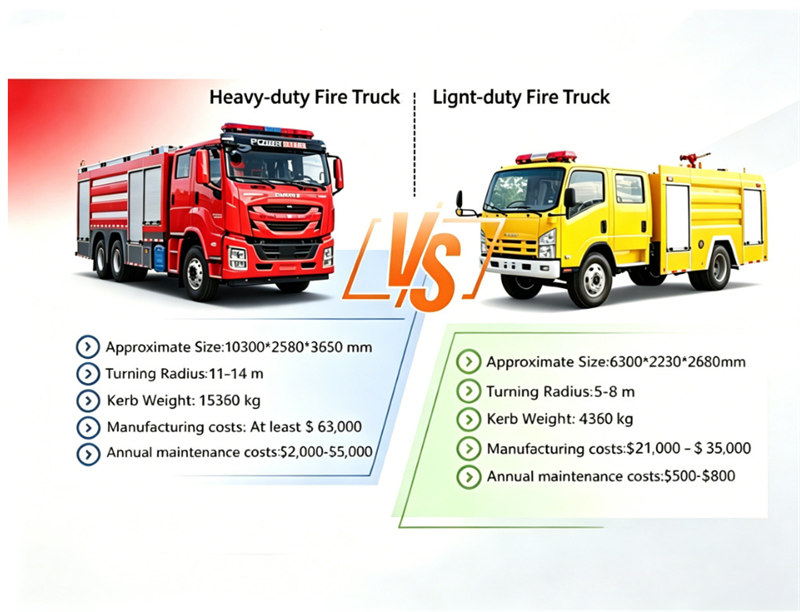
Fire rescue truck needs vary drastically between metropolitan areas and rural or small-town communities. Large urban fire departments rely on heavy duty fire trucks with massive water tanks, high rise ladders, and full industrial-grade configurations to handle high rise fires, industrial blazes, and large-scale emergencies. However, for small cities, rural towns, village fire stations, and volunteer fire departments, heavy fire trucks often become more of a burden than an advantage. This is why light fire trucks have become the mainstream and most practical solution for small city and rural fire departments worldwide. Balancing compact size, flexible mobility, complete basic rescue functions, and low overall costs, they perfectly match the daily rescue and fire prevention needs of grassroots fire teams. The light fire truck is a compact, lightweight emergency fire vehicle designed specifically for grassroots, suburban, and rural fire scenarios. I. Comparison between heavy duty fire trucks and light duty fire trucks: To clearly view the gap between heavy-duty and light fire trucks, we’ve prepared a direct comparison chart covering core practical metrics. Heavy models stretch over 10 meters with a 11–14m turning radius and 15 ton curb weight, costing at least $63,000 to build plus $2,000–$5,000 in yearly upkeep. By contrast, compact light fire trucks cut dimensions nearly in half, weigh only 4,360 kg, start at $21,000, and keep annual maintenance under $800, delivering far better mobility and budget value for rural & small-town stations. Ⅱ.Key highlights of light truck fire trucks: 1. Lightweight yet high-load bearing design. The total gross vehicle weight stays under 8,000 kg even when fully loaded, enabling ultra-fast emergency response. 2. All wheel drive customization is available to tackle rough, uneven road surfaces common in remote regions. 3. Full-spectrum firefighting functionality is fully retained: a. Dual independent tanks for water and fire suppression foam. b. Double-row crew cab to accommodate a full team of responding firefighters. c. Complete standard inventory of emergency rescue firefighting tools. d. Optional add-ons including scene lighting systems and towing equipment. 4. The power take-off (PTO) system serves as the core operation drive. It features intuitive controls and simple maintenance & component replacement. Durable core components cut long-term emergency operation expenses for rural and township fire departments significantly. Ⅲ.The following are the most popular light duty fire truck models: Chassis Model HOWO 1880 Drive system RHD/LHD, 4x2/4x4 can be optional Engine power 160HP Kerb weight 4350kg Capacity 3CBM water tank +1.5CBM foam tank Fire pump CB10/40 Fire cannon PL48 Working range 55m Chassis Model ISUZU NPR 700P Drive system RHD/LHD, 4x...
Details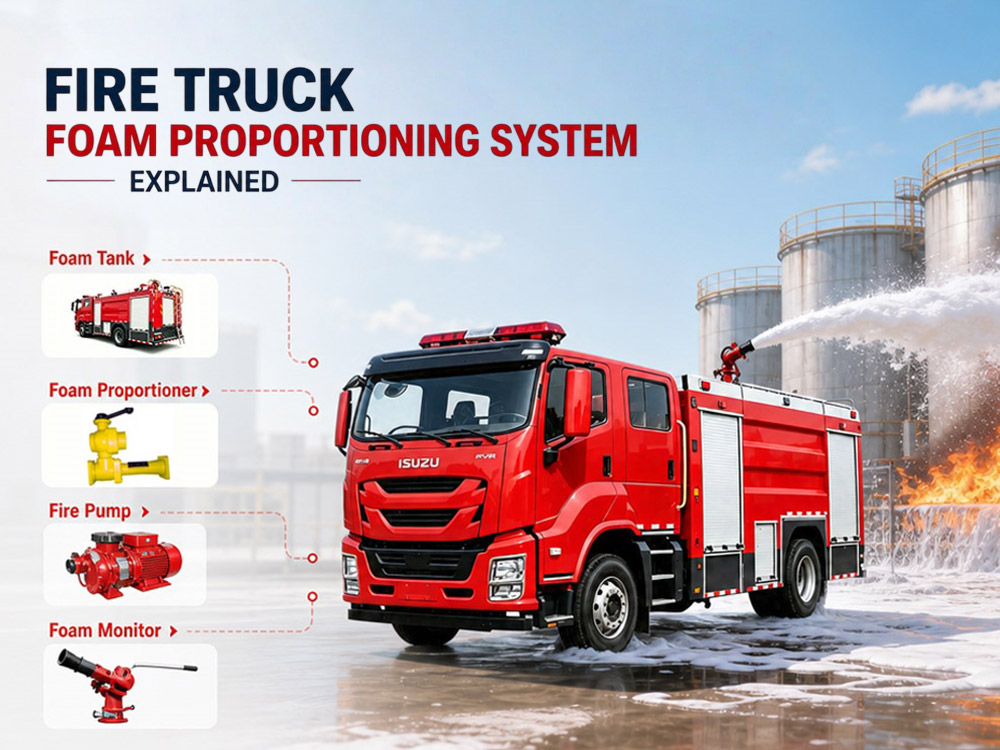
The fire truck foam system mixes water with foam concentrate at precise ratios (1%, 3%, or 6%) to create a foam solution. This solution is then pressurized by the fire pump and expanded with air through foam nozzles — this is the core working principle of how a foam fire truck mixes foam and water — ultimately producing a stable foam blanket that covers the fuel surface. This process increases firefighting efficiency by over 50% while reducing foam concentrate waste by 30%. » I. Why Does a Fire Truck Need a Foam System? Compared to using water alone, foam offers three key advantages: 1. Oxygen Isolation — Foam covers the burning surface, forming a dense physical barrier that prevents oxygen from reaching the combustion zone, thereby suppressing the fire. 2. Temperature Reduction — The water content in the foam solution absorbs large amounts of heat as it evaporates, rapidly reducing the temperature of the burning area. 3. Re-ignition Prevention — The foam layer continues to cover the fire area even after extinguishment, effectively isolating oxygen and flammable vapors, significantly reducing the risk of re-ignition. » II. Core Working Principles of the Foam System 1. Proportioning System: Water flows through the proportioner → creates negative pressure (negative pressure system) or uses a foam pump (positive pressure system) → draws foam concentrate from the foam tank → mixes at preset ratio (1%, 3%, or 6%) → foam solution flows to the pump. 2. Pump Pressurization: The foam solution enters the centrifugal pump → pressurized to 0.8–1.2 MPa → delivered through piping to discharge outlets or the foam monitor. 3. Foam Expansion: The pressurized foam solution passes through a foam nozzle or aerating device → air is entrained → the solution expands into finished foam → covers the fuel surface → cuts off oxygen and suppresses the fire. Key Concept: Foam concentrate + water does not equal finished foam. The mixed foam solution is still a liquid — it must be combined with air through a foam nozzle to become true firefighting foam. When the high-pressure foam solution passes through the nozzle at high speed, it creates a localized negative pressure zone that forcibly draws in air. The air and liquid collide and shear violently inside the nozzle, instantly breaking down into millions of tiny bubbles that accumulate to form white foam. » III. How Does a Fire Truck Mix Foam and Water? The foam mixing process on a fire truck consists of four main steps, from water supply to final foam formation. Step 1: The Fire Pump Provides Water Flow After the fire truck is started, the fire pump provides power for the foam system. Water sources can include the onboard tank, fire hydrant, rivers, lakes, or reservoirs. The fire pump is responsible for building water pressure, providing stable flow, and pushing water into the foam propor...
Details
Please subscribe latest fire trucks news, and Warmly welcome to tell us what you think.

 IPv6 network supported
Links :
ISUZU Trucks
CEEC Trucks
CS Trucks
IPv6 network supported
Links :
ISUZU Trucks
CEEC Trucks
CS Trucks

 English
 français
 Deutsch
 русский
 italiano
 español
 português
 Nederlands
 العربية
 日本語
日本語 한국의
한국의 Türkçe
 Melayu
 ไทย
ไทย Tiếng Việt
 Indonesia
  中文
中文 қазақ
қазақ Filipino
 မြန်မာ
 српски