Leave A Message
If you are interested in our products and want to know more details,please leave a message here,we will reply you as soon as we can.

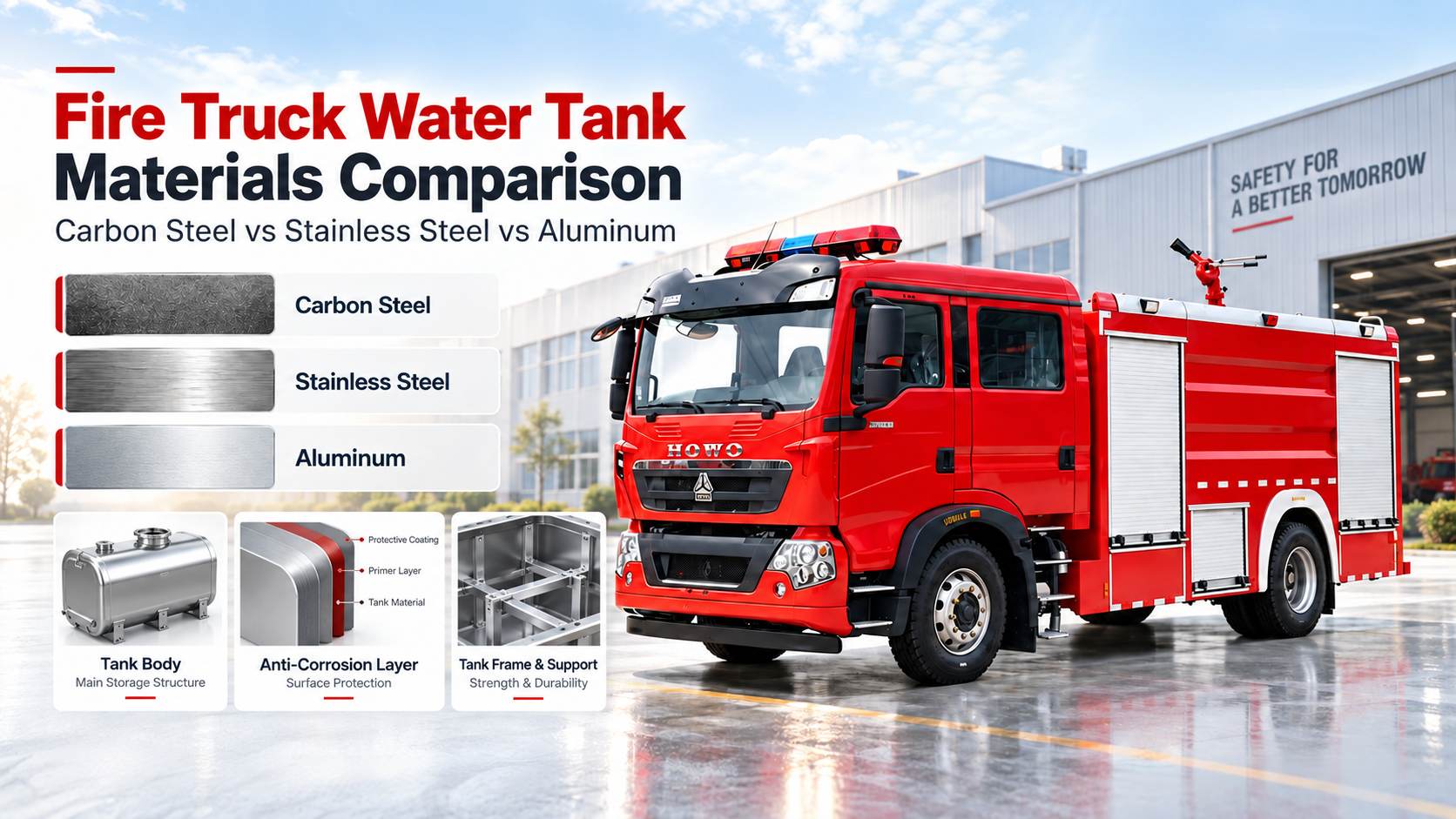
Fire Truck Water Tank Materials Comparison: Carbon Steel vs Stainless Steel vs Aluminum
During fire apparatus procurement, our customers typically prioritize chassis performance, fire pump flow and pressure ratings, and firefighting system configuration. However, the choice of fire truck water tank material is equally important, as it directly affects the vehicle's service life, corrosion resistance, maintenance cost, and long-term operational reliability.
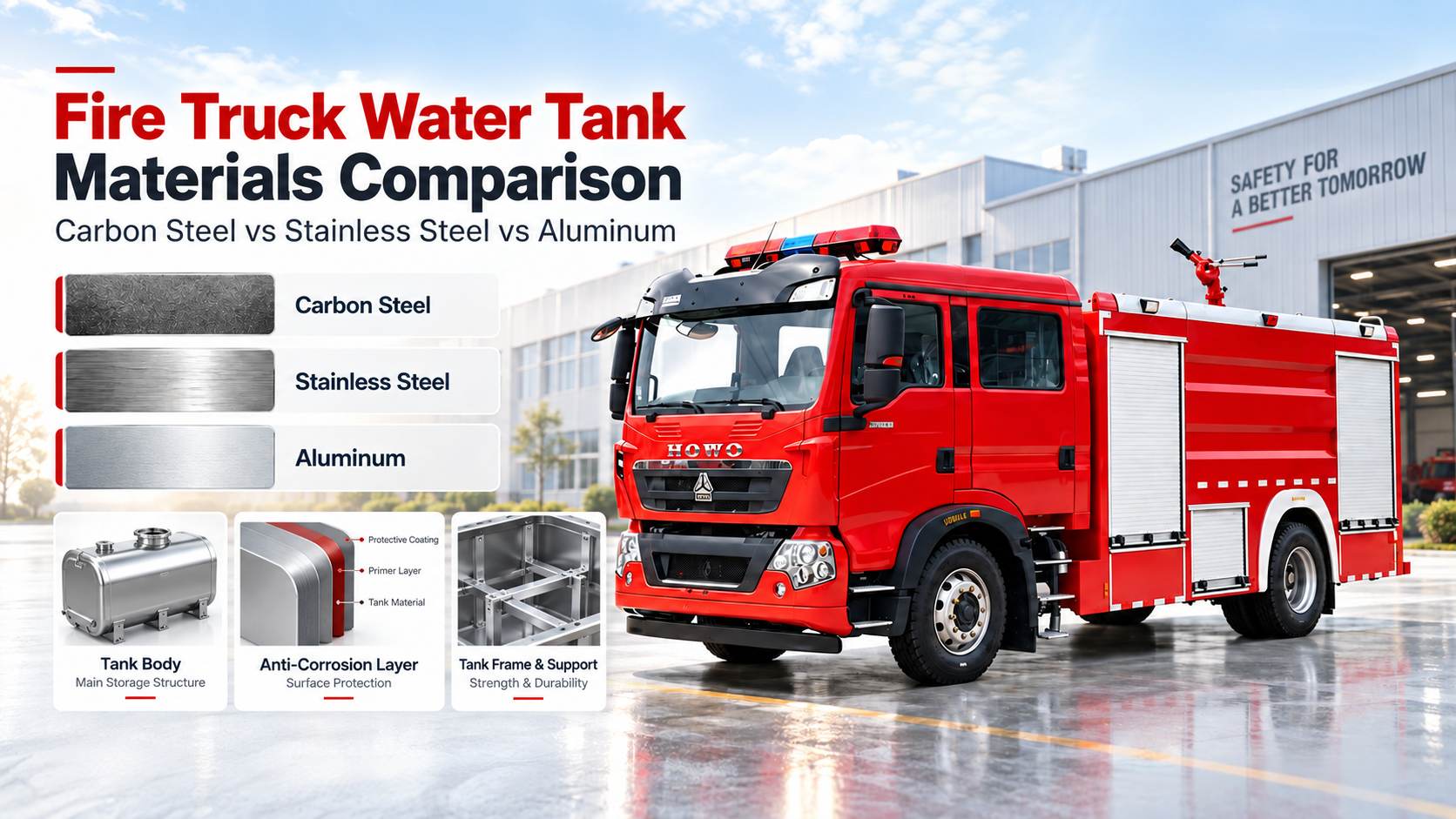
As a professional fire truck manufacturer, we understand that water tank material selection is not merely a price comparison, but a comprehensive engineering decision. This article compares the three most common fire truck water tank materials—carbon steel, stainless steel, and aluminum—based on engineering requirements, real-world performance, and lifecycle cost.
I. Structure of a Fire Truck Water Tank
Before comparing materials, it is important to understand that a water tank is not simply a container for water. A modern apparatus water tank is a pressure-bearing and surge-suppressing structure integrated into the vehicle body. It must withstand fill pump pressure, water surge during braking and cornering, road vibration, and chemical attack from firefighting foam and reclaimed water.
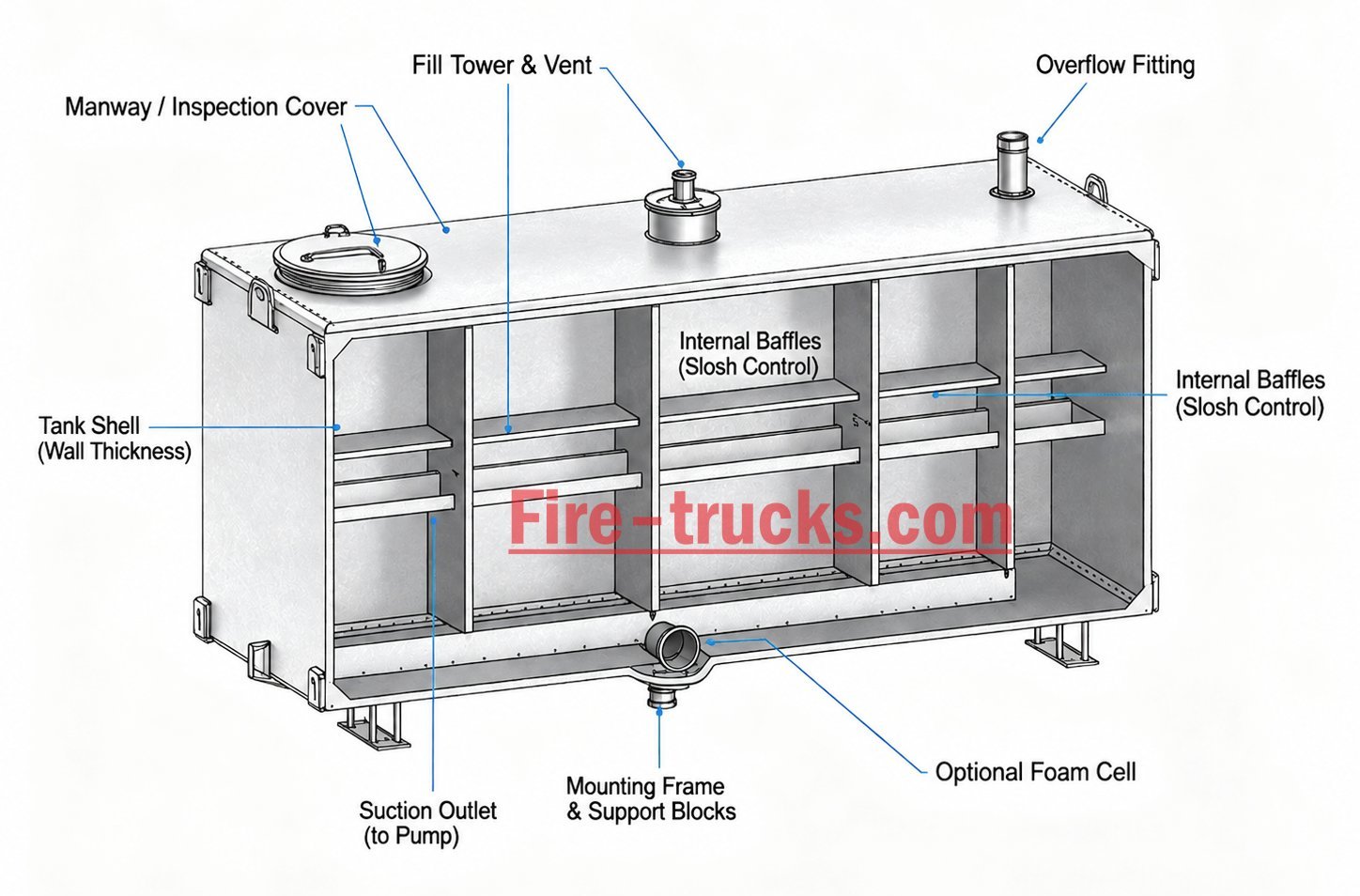
Typical internal and external features include:
• Internal baffles — welded partitions that suppress water surge and stabilize vehicle handling
• Fill tower and vent — top fill opening with vent to prevent vacuum or pressure lock
• Manhole / inspection cover — sealed opening for personnel access for internal inspection and cleaning
• Pump suction port — connection that delivers water from the tank to the fire pump
• Overflow port — prevents over-pressurization during filling
• Mounting brackets and support blocks — isolate chassis twisting; slotted mounts allow thermal expansion and contraction
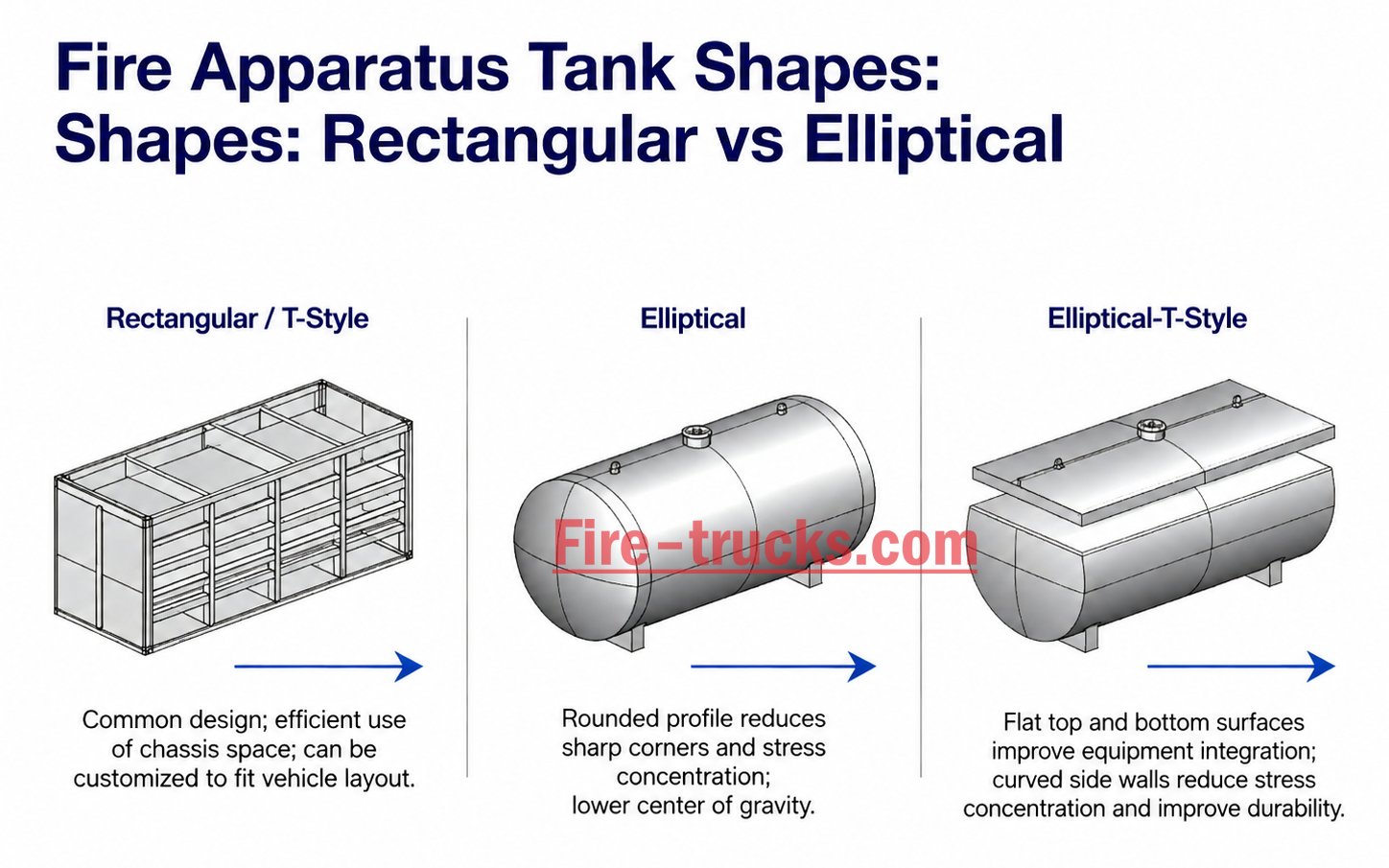
Water tanks are available in rectangular/T-shaped and elliptical configurations. Elliptical tanks have no sharp corners where welding stress concentrates, but they have a higher center of gravity and often require stainless steel cladding for appearance. Tank material is closely related to these features—welds, baffles, and connections—not just the exterior surface.
II. Three Key Materials Used in Fire Truck Water Tanks
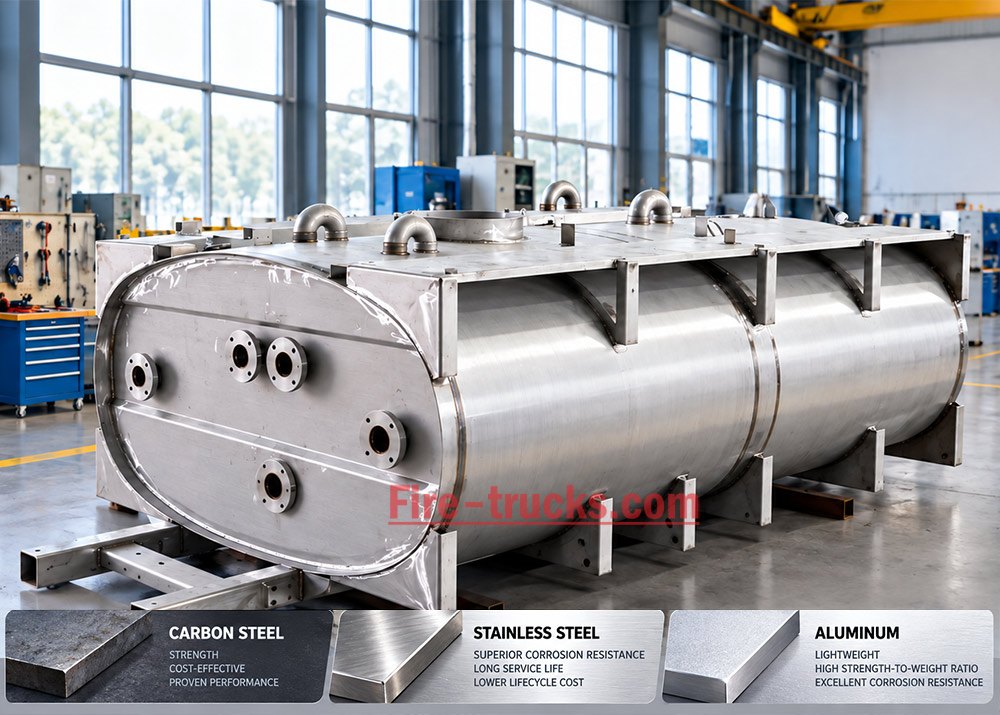
1. Carbon Steel
Typically Q235B or Q345R, with internal epoxy coating. High strength, mature welding processes, low cost, but requires regular coating maintenance and has a shorter service life (5–8 years).
• Lowest initial material and manufacturing cost
• Easy to weld, cut, and repair in the workshop
• Heaviest option, reducing payload capacity
• Requires internal and external coating (epoxy, galvanized, or paint)
• Coating damage leads to rapid pitting of bare steel
2. Stainless Steel
Typically SUS304 or SUS316L. Excellent corrosion resistance, long service life (15+ years), hygienic surface, but higher initial cost and requires careful welding practices.
• Self-repairing chromium oxide (Cr₂O₃) film
• No internal coating required
• Highest material cost
• Brushed or mirror finish suitable for exposed appearance
• Requires attention to cracking and microbiologically influenced corrosion
3. Aluminum
Typically marine-grade 5083 alloy. Lightweight (one-third the density of steel), naturally corrosion-resistant, excellent fatigue resistance, but lower strength and requires specialized fabrication.
• Density approximately one-third that of steel
• Natural Al₂O₃ film resists atmospheric corrosion
• Excellent strength-to-weight ratio, suitable for aerial ladders
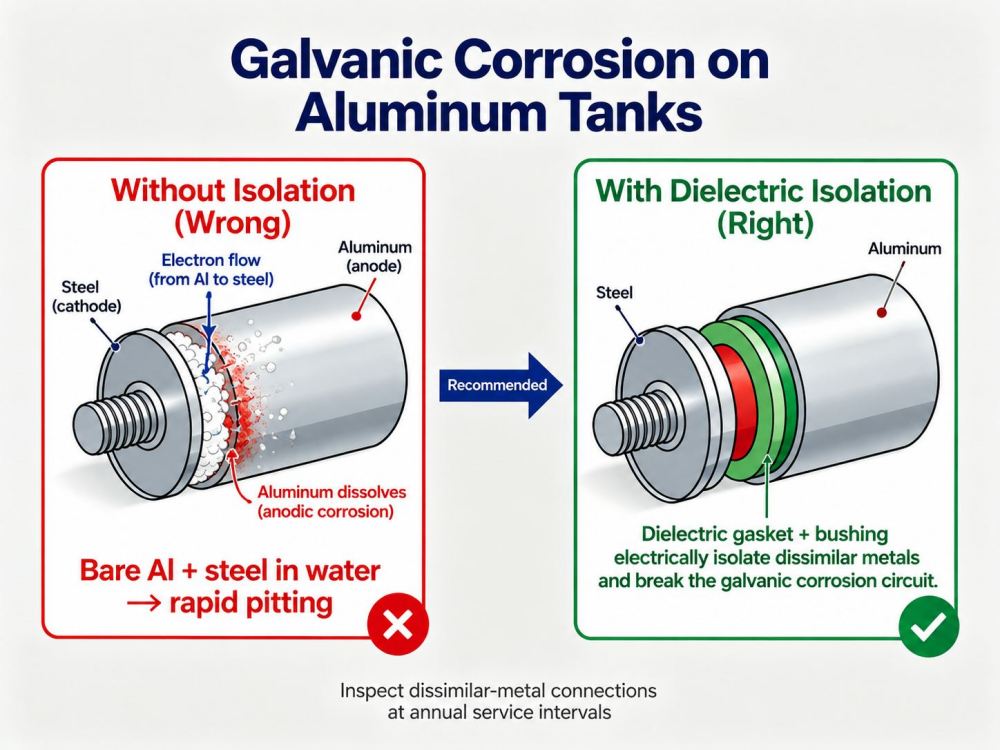
• Galvanic corrosion risk when connected to steel fittings
• Lower impact toughness than steel
III. Corrosion Resistance
The difference between the three materials is essentially a story of surface chemistry. The following describes what happens at the metal-water interface for each material.
Carbon steel: Bare carbon steel rusts rapidly when exposed to water. It must be protected by an internal anti-corrosion coating, typically epoxy resin or polyurethane. If the coating is scratched or degraded, the underlying steel corrodes, and rust particles can be washed into the fire pump and damage the impeller.
Stainless steel: Forms a passive chromium oxide layer that resists rust and chemical attack. SUS304 is suitable for freshwater storage, while SUS316L—containing molybdenum—offers superior resistance to chloride-induced corrosion, making it suitable for coastal areas or chlorinated water sources. However, if fabrication quality is poor, stainless steel can still corrode at weld seams and heat-affected zones.
Aluminum: Forms a protective oxide layer that resists corrosion, eliminating the need for internal coating. However, when connected to dissimilar metals (such as steel or brass fittings), galvanic corrosion can occur. Cathodic protection and protective coatings are recommended at connection points.
IV. Mechanical Strength and Stiffness
Carbon steel: Offers excellent mechanical strength and stiffness, making it suitable for large-capacity tanks where structural rigidity is critical. Yield strength is typically around 350 MPa.
Stainless steel: Achieves a good balance between strength and corrosion resistance, with tensile strength typically around 540 MPa.
Aluminum: Has lower yield strength and tensile strength than carbon or stainless steel, which may limit its use in very large tanks or high-stress applications. Yield strength is typically around 275 MPa.
V. Weight and Payload Impact
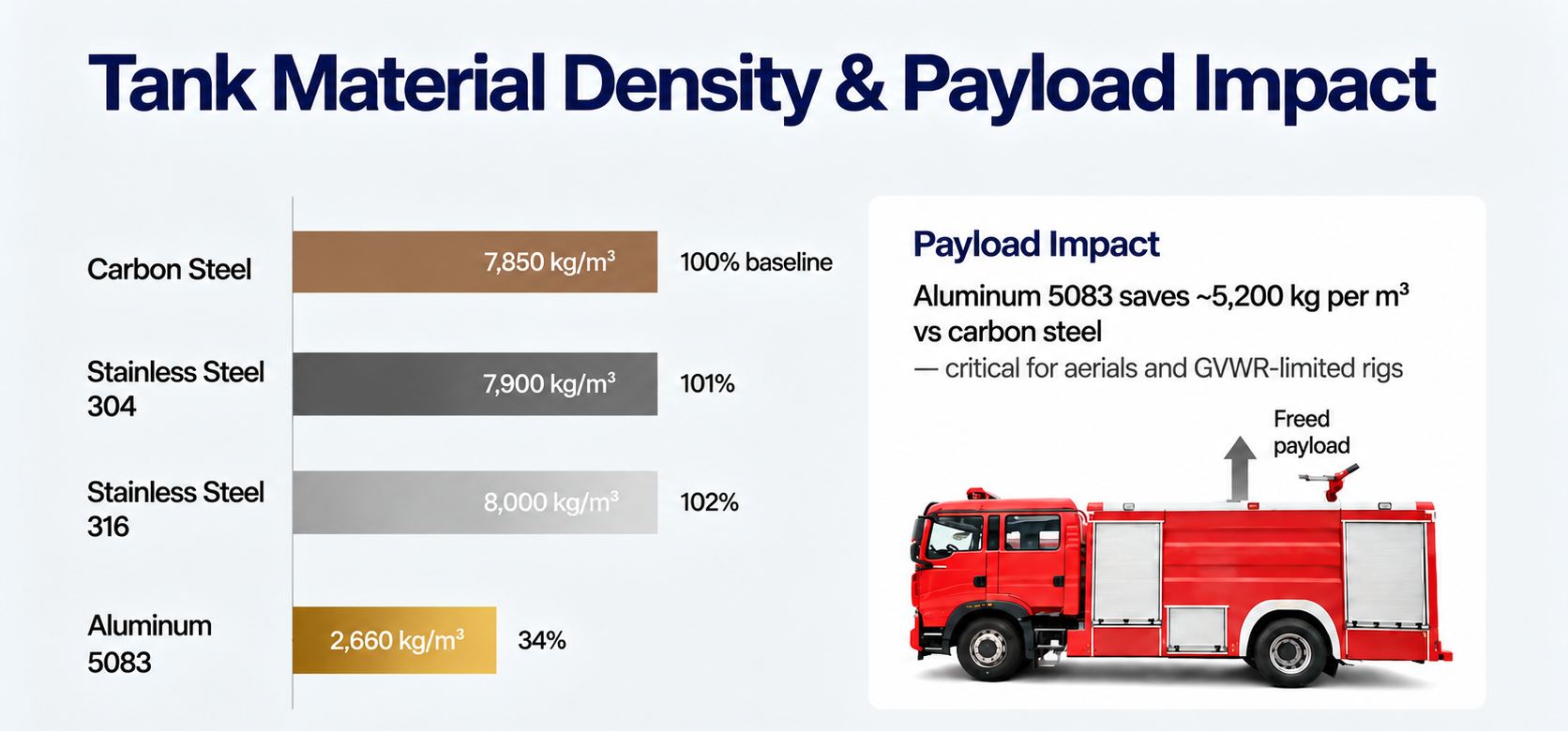
Carbon steel: Density of 7.85 g/cm³. Heavy, but strength allows for thinner plates in some applications.
Stainless steel: Density of approximately 8 g/cm³. Similar weight to carbon steel.
Aluminum: Density of 2.7 g/cm³—roughly one-third that of steel. This directly translates to increased payload capacity or reduced fuel consumption, making it ideal for weight-sensitive applications.
VI. Service Life and Maintenance
Carbon steel: 5–8 years with proper coating maintenance. Requires regular inspection (every 6 months) and coating repair. Shorter service life means higher replacement frequency.
Stainless steel: 15+ years with proper maintenance. Low maintenance burden. The smooth interior surface resists algae and bacterial growth.
Aluminum: 15–20 years in demanding environments. No internal coating required, but requires inspection of welds and dissimilar metal connections.
The choice of fire truck water tank material is not a simple price comparison, but a lifecycle cost decision based on water quality, operating environment, payload requirements, and maintenance capability.
How to Maintain a Fire Truck Water Tank & Checklist
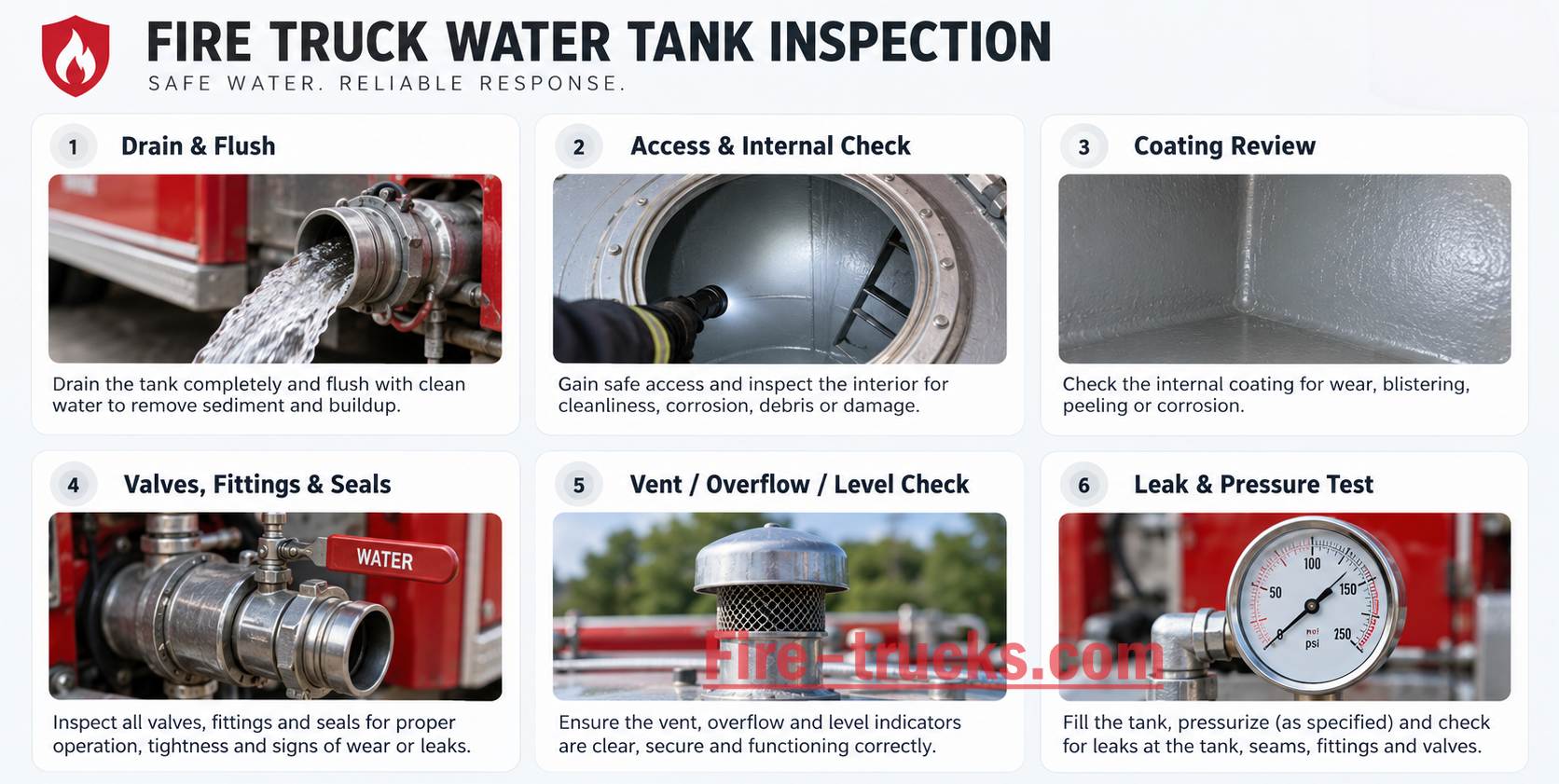
1. Drain all remaining water after each shift to prevent freezing cracks in winter.
2. Flush the tank and pipes immediately after using unclean water sources.
3. Check seals, tank leaks, and valve operation weekly.
4. Drain and remove sediment and scale from the tank monthly.
5. Clean the interior and inspect welds yearly; sand rust spots and apply epoxy resin paint.
6. Replace stored water regularly to prevent deterioration and corrosion.
VII. Fire Truck Tank Material Performance Comparison Table
| Item | Carbon Steel | Stainless Steel | Aluminum |
| Cost | Low | High | Moderate |
| Weight | Heavy | Moderate | Lightweight |
| Corrosion Resistance | Fair | Excellent | Good |
| Strength | Excellent | Excellent | Good |
| Maintenance Requirement | High | Low | Moderate |
| Manufacturing Difficulty | Low | Moderate | High |
| Service Life | Moderate | Long | Long |
Which Material Should You Choose?
• Choose carbon steel: For budget ground pumpers in dry inland climates, where the fleet has an active maintenance program and commits to annual internal inspection and coating repair.
• Choose stainless steel (304): For standard municipal apparatus requiring a coating-free, low-maintenance shell with a clean appearance; specify 316 for coastal, salt-spray, or chemical environments.
• Choose aluminum (5083): For aerial ladder trucks where every pound of tank weight saved translates into useful payload—provided that electrical isolation at all steel-aluminum connections is verified on the production line.
VIII. Frequently Asked Questions (FAQ)
Q1: How often should the inside of a water tank be inspected?
A: Coated carbon steel tanks should be inspected every 6 months, while stainless steel and aluminum tanks should be inspected annually. If natural water sources, foam concentrate, or coastal operations are common, the inspection interval should be shortened accordingly. Results should be recorded after each inspection to establish a maintenance file.
Q2: What is the difference between SUS304 and SUS316L for fire truck tanks?
A: SUS304 is suitable for freshwater storage and inland operations. SUS316L contains molybdenum, which significantly improves resistance to chloride-induced pitting corrosion. If you operate in a coastal environment or use high-chloride water sources, SUS316L is the better choice. For inland departments using municipal water, SUS304 is generally sufficient.
Q3: Do aluminum fire truck tanks need internal coating?
A: No. Aluminum naturally forms a protective oxide layer that resists corrosion, eliminating the need for internal coating. This is one of the main advantages of aluminum tanks—it removes the coating maintenance requirement that carbon steel tanks have. However, aluminum tanks still require isolation measures at dissimilar metal connections to prevent galvanic corrosion.
Q4: Which fire truck tank material is best for coastal areas?
A: For coastal areas, choose either stainless steel SUS316L or aluminum. SUS316L contains molybdenum, which resists chloride-induced pitting corrosion. Aluminum naturally resists salt spray corrosion and requires no internal coating. SUS304 should be avoided in coastal environments unless additional protective measures are taken, as chloride-rich air and water can cause pitting corrosion over time.
Q5: Why do stainless steel fire truck tanks sometimes rust?
A: Stainless steel corrosion typically occurs at weld seams, heat-affected zones, or areas contaminated with iron during fabrication. High-chloride water can also cause pitting corrosion. Proper welding (continuous, cleaned), surface protection during fabrication, and optional internal coating can prevent this. If you operate in a coastal area, specify SUS316L instead of SUS304 for better chloride resistance.
Q6: How long does a fire truck water tank last?
A: Service life depends on the material: carbon steel tanks last 5–8 years with proper coating maintenance; stainless steel tanks last 15+ years; aluminum tanks last 15–20 years. Actual service life is also affected by water quality, operating environment, and maintenance practices.
IX. Conclusion
The choice of fire truck water tank material is not a simple price comparison, but a lifecycle cost decision based on water quality, operating environment, payload requirements, and maintenance capability:
Water quality → Operating environment → Payload priority → Maintenance capability → Material selection
• Carbon steel: Lowest upfront cost, high strength, but requires diligent coating maintenance and has the shortest service life (5–8 years)
• Stainless steel: Industry standard, excellent corrosion resistance, long service life (15+ years), low maintenance—the safest default choice for most fire departments
• Aluminum: Lightest option, natural corrosion resistance, excellent fatigue resistance—ideal for payload-sensitive, coastal, and high-duty applications


You may be interested in the following information
During fire apparatus procurement, our customers typically prioritize chassis performance, fire pump flow and pressure ratings, and firefighting system configuration. However, the choice of fire truck water tank material is equally important, as it directly affects the vehicle's service life, corrosion resistance, maintenance cost, and long-term operational reliability. As a professional fire truck manufacturer, we understand that water tank material selection is not merely a price comparison, but a comprehensive engineering decision. This article compares the three most common fire truck water tank materials—carbon steel, stainless steel, and aluminum—based on engineering requirements, real-world performance, and lifecycle cost. I. Structure of a Fire Truck Water Tank Before comparing materials, it is important to understand that a water tank is not simply a container for water. A modern apparatus water tank is a pressure-bearing and surge-suppressing structure integrated into the vehicle body. It must withstand fill pump pressure, water surge during braking and cornering, road vibration, and chemical attack from firefighting foam and reclaimed water. Typical internal and external features include: • Internal baffles — welded partitions that suppress water surge and stabilize vehicle handling • Fill tower and vent — top fill opening with vent to prevent vacuum or pressure lock • Manhole / inspection cover — sealed opening for personnel access for internal inspection and cleaning • Pump suction port — connection that delivers water from the tank to the fire pump • Overflow port — prevents over-pressurization during filling • Mounting brackets and support blocks — isolate chassis twisting; slotted mounts allow thermal expansion and contraction Water tanks are available in rectangular/T-shaped and elliptical configurations. Elliptical tanks have no sharp corners where welding stress concentrates, but they have a higher center of gravity and often require stainless steel cladding for appearance. Tank material is closely related to these features—welds, baffles, and connections—not just the exterior surface. II. Three Key Materials Used in Fire Truck Water Tanks 1. Carbon Steel Typically Q235B or Q345R, with internal epoxy coating. High strength, mature welding processes, low cost, but requires regular coating maintenance and has a shorter service life (5–8 years). • Lowest initial material and manufacturing cost • Easy to weld, cut, and repair in the workshop • Heaviest option, reducing payload capacity • Requires internal and external coating (epoxy, galvanized, or paint) • Coating damage leads to rapid pitting of bare steel 2. Stainless Steel Typically SUS304 or SUS316L. Excellent corrosion resistance, long service life (15+ years), hygienic surface, but higher initial cost and re...
Details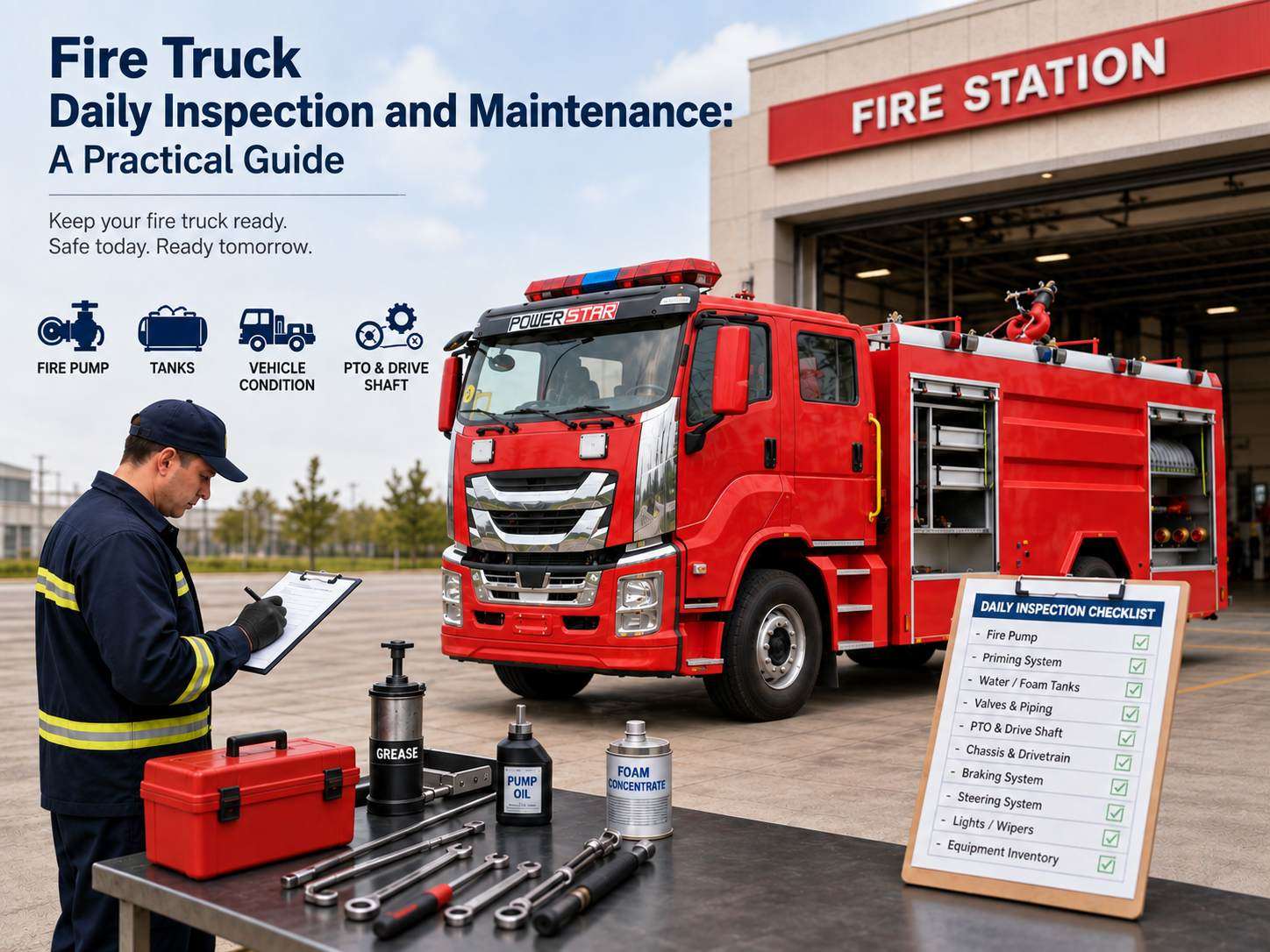
The reliability of a fire truck depends on the maintenance system behind it. Proper operation and responsible use of fire apparatus and specialized firefighting equipment are essential to ensuring that the vehicle performs its function—and directly determine whether a fire truck can complete firefighting and rescue tasks quickly in an emergency. Fire departments worldwide follow structured daily inspection routines to keep vehicles and equipment in a constant state of operational readiness. Based on maintenance practices adopted by fire departments and fire apparatus manufacturers, this article focuses on the key areas that require attention during daily inspection and maintenance—specifically the fire pump, water and foam tanks, vehicle condition, PTO, and fire pump drive shaft. Quick Answer Daily fire truck maintenance focuses on four core areas: the fire pump, the water and foam tanks, the chassis and drivetrain, and the power take-off (PTO) and drive shaft. Key practices include lubricating pump rotating components every 3–6 hours of operation, testing pump performance parameters regularly, flushing tanks and piping after foam use, inspecting chassis fasteners and brake systems, and checking PTO engagement and drive shaft lubrication. Corrosion in tanks and piping is a leading cause of pump impeller damage and foam system failure. I. Fire Pump Inspection and Maintenance The fire pump is one of the most important components of a fire truck, as it is responsible for delivering water or foam solution to the firefighting system. Its maintenance directly affects the effectiveness of firefighting operations. Inspection and maintenance of the fire pump must therefore be performed with particular care—any fault detected should be addressed immediately. Daily fire pump maintenance primarily covers the following areas. 1. Lubrication Rotating components of the fire pump should generally be greased once every 3 to 6 hours of operation. 2. Checking fire pump performance Important operating parameters of the fire pump should be checked regularly, including: • Maximum suction depth• Priming time• Maximum flow rate• Other specified fire pump performance parameters If the measured performance differs significantly from the pump's normal operating condition, the cause should be investigated further. 3. Cleaning the fire pump after using an unclean water source If the fire truck draws water from an unclean or contaminated source, the fire pump, water tank, and piping system should be cleaned after the operation is complete. Contaminants entering the system can affect the normal operation of valves, piping, and internal pump components. This is particularly important for fire trucks that draw from natural sources or other non-municipal water supplies. 4. Flushing the system after foam operations After using foam for firefighting, the fire pump, foam proportioning system, and connected piping should be cleaned promptly...
Details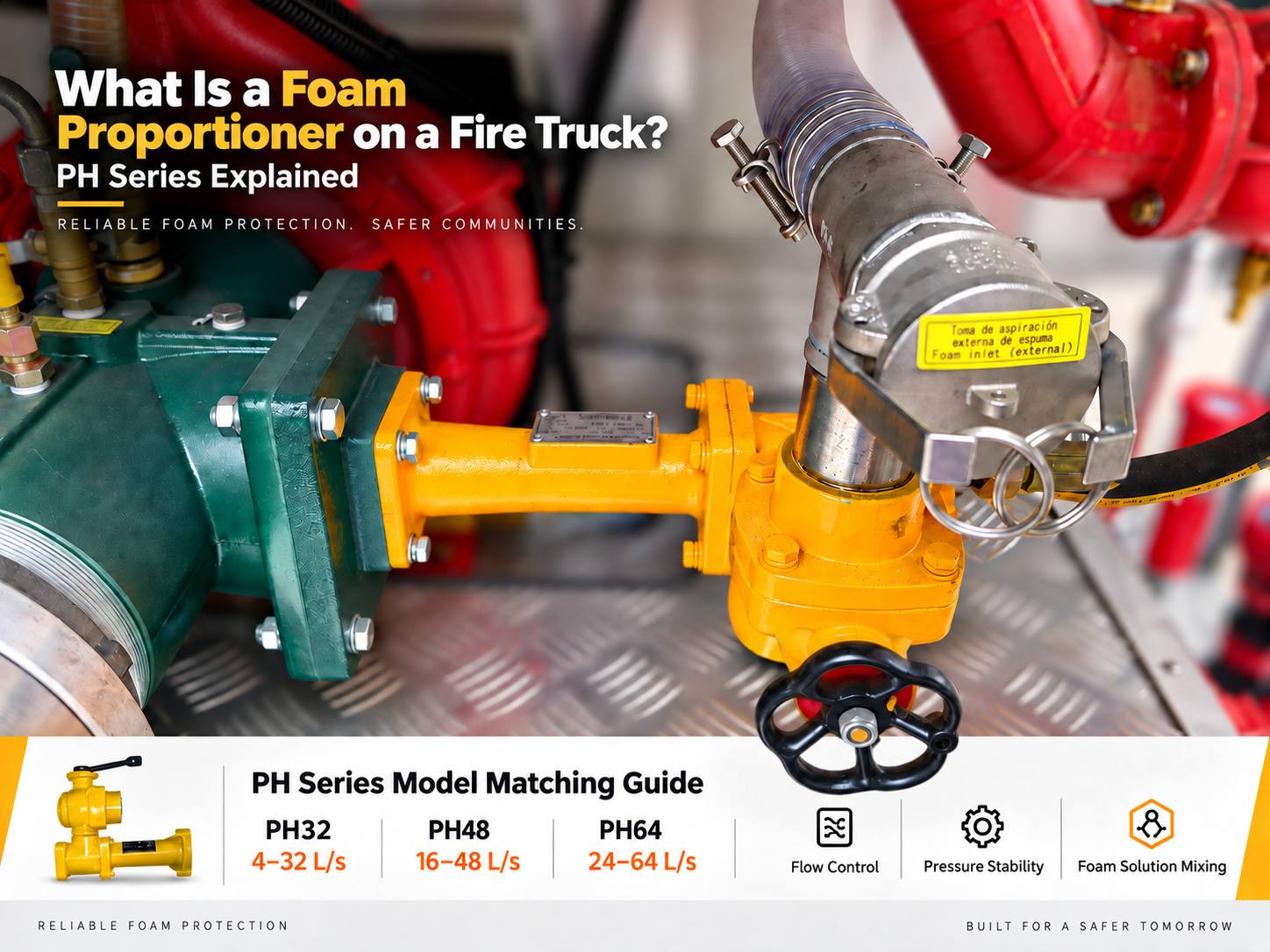
The PH series around-the-pump foam proportioner is a professional foam concentrate suction and delivery device designed specifically for foam firefighting systems and fire trucks. It is installed within the supporting fire truck fire pump and water supply system and serves as the core device for achieving automatic proportional mixing of foam concentrate and clean water. Unlike traditional manual mixing equipment, this proportioner operates on the principle of water pressure differential: according to the selected flow rate setting, it draws a precise amount of foam concentrate from the foam tank, delivers the foam concentrate to the fire pump inlet, and thoroughly mixes it with pressurized water to form a uniform foam solution. The properly mixed solution is then delivered to foam-generating devices or discharge equipment for efficient firefighting operations. I. Structure of the PH Series Foam Proportioner 1. Adjustment Handle and Indicator Plate The indicator plate is marked with different values corresponding to the mixed solution flow rates required by the connected foam-generating devices. Rotating the adjustment handle to the required flow rate position sets the operating flow rate of the proportioner. 2. Regulating Valve The regulating valve controls the amount of foam concentrate passing through the proportioner based on the handle setting. Once the handle position is determined, the valve opening determines the foam concentrate suction flow rate. 3. Narrowed Flow Passage Section (Negative Pressure Generation Section) This is the core component of the proportioner. As water flows through this narrowed passage, its velocity increases and its pressure drops below atmospheric pressure, creating a negative pressure. This negative pressure is transmitted to the foam concentrate suction port, drawing foam concentrate from the storage tank. 4. Mixing Chamber The mixing chamber is where foam concentrate enters the water stream. The foam concentrate merges with the water here to form foam solution. An arrow cast on the mixing chamber exterior indicates the flow direction—the arrow tail connects to the pump discharge line, and the arrow head connects to the pump inlet line. 5. Diffuser Tube The diffuser tube reduces the velocity of the mixed solution as it exits the proportioner, converting kinetic energy back into pressure energy so that the mixed solution enters the pump inlet line at an appropriate pressure. II. How Does the PH Series Foam Proportioner Work? The PH series around-the-pump foam proportioner uses the water flow and pressure conditions within the fire pump system to draw foam concentrate from the foam tank, introduce it into the fire pump inlet, and mix it with water to form foam solution. The fire pump then pressurizes the mixed solution again and delivers it to downstream foam discharge equipment. Step 1: The fire pump pressurizes the water Water enters the fire pump from the fire truck's water tank or another suitable wate...
Details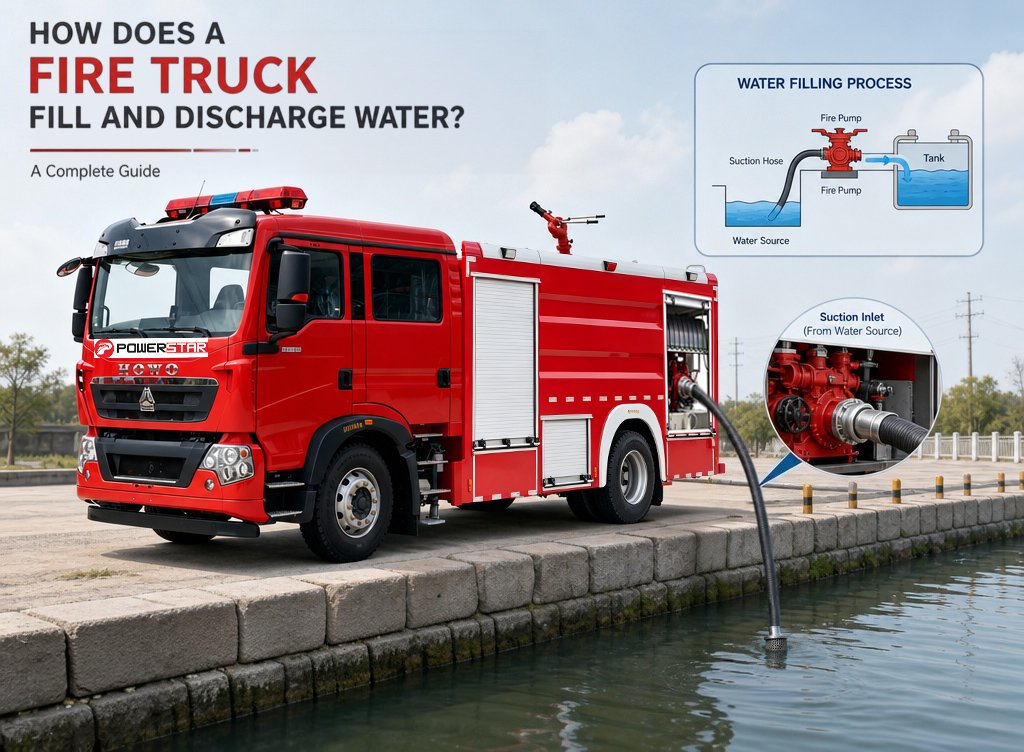
The effectiveness of firefighting operations depends heavily on the reliability and design of a fire truck's water supply system. A properly designed fire truck water system allows the vehicle to fill its water tank from an external water source, draft water from suitable static sources when necessary, and deliver pressurized water through hoses, nozzles, or fire monitors. This article explains how fire trucks fill their tanks from hydrants or suitable external water sources, how the priming system works during drafting, and how the fire pump pressurizes water for discharge through hoses, nozzles, or fire monitors. Quick Answer A fire truck normally fills its water tank in two main ways: 1. External water supply: Water is supplied from a hydrant or another pressurized source through the truck's external filling connection. 2. Drafting from a static water source: A suction hose, strainer, fire pump, and priming system are used to draw water from a pond, river, lake, or other suitable source. Once water is available in the onboard tank, the fire pump draws water from the tank and sends it to hose outlets, nozzles, or a fire monitor at the required pressure and flow rate. The complete water flow path can be simplified as: External water source → Intake/Filling system → Water tank → Fire pump → Discharge outlets I. Filling the Tank from a Fire Hydrant Connecting to a suitable fire hydrant is one of the most direct and commonly used ways to fill a fire truck's water tank when a pressurized water supply is available. It generally requires less equipment and setup than drafting from a static source. Equipment needed: A suitable filling hose with a coupling compatible with the hydrant and the fire truck's external fill connection. Hose diameter, coupling type, and connection standards vary by vehicle, manufacturer, and region. Step-by-step procedure: • Connect one end of the hose to the hydrant outlet and the other end to the external fill port on the fire truck • Open the hydrant gradually and confirm that water is flowing normally through the filling line • Water flows into the onboard tank through the filling line under the available water supply pressure • Monitor the tank level gauge and close the hydrant when the tank is full Key considerations: • Ensure the hose connection is tight to prevent leaks • Verify that the external fill valve on the truck is fully open before starting • Do not leave the filling operation unattended. Monitor the tank level and stop filling when the tank reaches its specified capacity to prevent overflow and unnecessary stress on the tank venting system. II. Drafting Water from a Static Source via the Fire Pump When a hydrant is not available—common in rural areas, forests, or industrial sites—fire trucks must draft water from static sources such as ponds, rive...
Details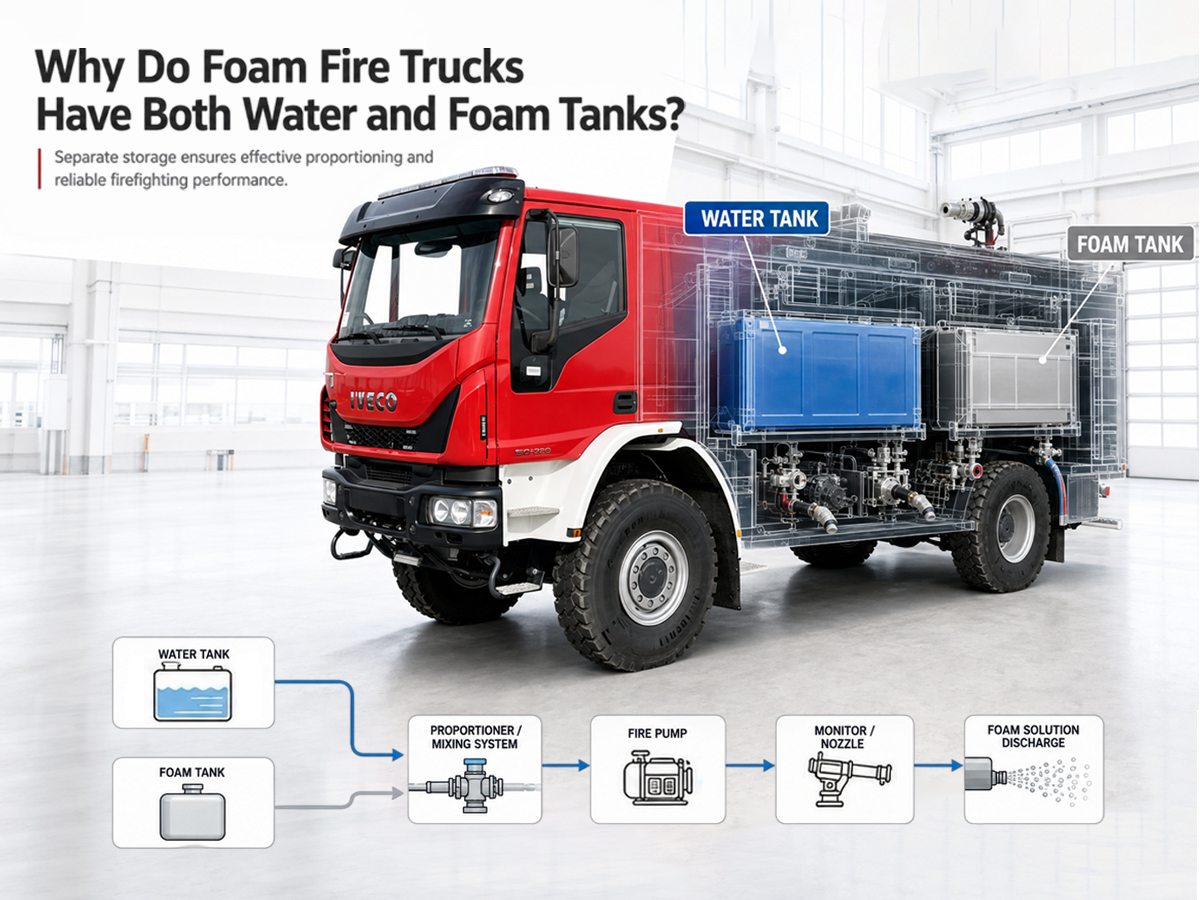
Foam fire trucks combine a dedicated foam concentrate tank with a separate water tank and a precision proportioning system. They use a proportioning system to introduce foam concentrate into the water stream at a specified concentration, commonly 1%, 3%, or 6%, depending on the foam concentrate and firefighting application. The dual-tank design allows firefighters to use water alone when foam is not required and introduce foam concentrate only when needed. This improves operational flexibility, helps control foam consumption, and allows the firefighting system to be configured for different fire hazards. The core working principle and key technology of foam fire trucks, particularly why they have both water and foam tanks—are the focus of many customers. Let's learn about it today. Quick Answer: Foam fire trucks normally use separate water and foam concentrate tanks because water and foam concentrate are required in different proportions and are intended to be combined during operation rather than stored as a premixed solution for long periods. The water tank provides the main water supply, while the foam tank stores concentrated foam agent. A proportioning system controls how much concentrate is introduced into the water stream, allowing the truck to switch between water-only and foam firefighting modes. I. What Are the Main Components of a Foam Fire Truck? 1. Water Tank Corrosion-resistant construction (carbon steel with anti-corrosion coating or stainless steel), capacities ranging from 4,000 to 6,000 liters. Equipped with baffles to reduce liquid surging during vehicle movement and flexible mounts to absorb chassis flexing on rough terrain. 2. Foam Concentrate Tank Stainless steel construction to resist chemical attack from active foam concentrates, typically 500-2,000 liters capacity. Depending on the foam concentrate and system design, the tank may incorporate features such as circulation or agitation arrangements to help maintain concentrate condition during storage. 3. Foam Proportioning System A proportioning system that draws foam concentrate from the dedicated foam tank and introduces it into the water stream at a specified concentration. Depending on the foam concentrate and system design, proportioning may use balanced-pressure, pump-driven, or venturi-based technology. 4. Fire Pump The fire pump is the power source of the entire foam system. It draws water from the water tank and pressurizes it to the required flow and pressure for firefighting operations. The pump is typically driven by the vehicle's power take-off (PTO) or an independent engine, and must be compatible with the proportioning system to ensure accurate foam concentrate injection across varying flow rates. Common configurations include single-stage centrifugal pumps for standard operations and multi-stage pumps for high-pressure applications. 5. Foam Monitor The foam monitor deliver...
Details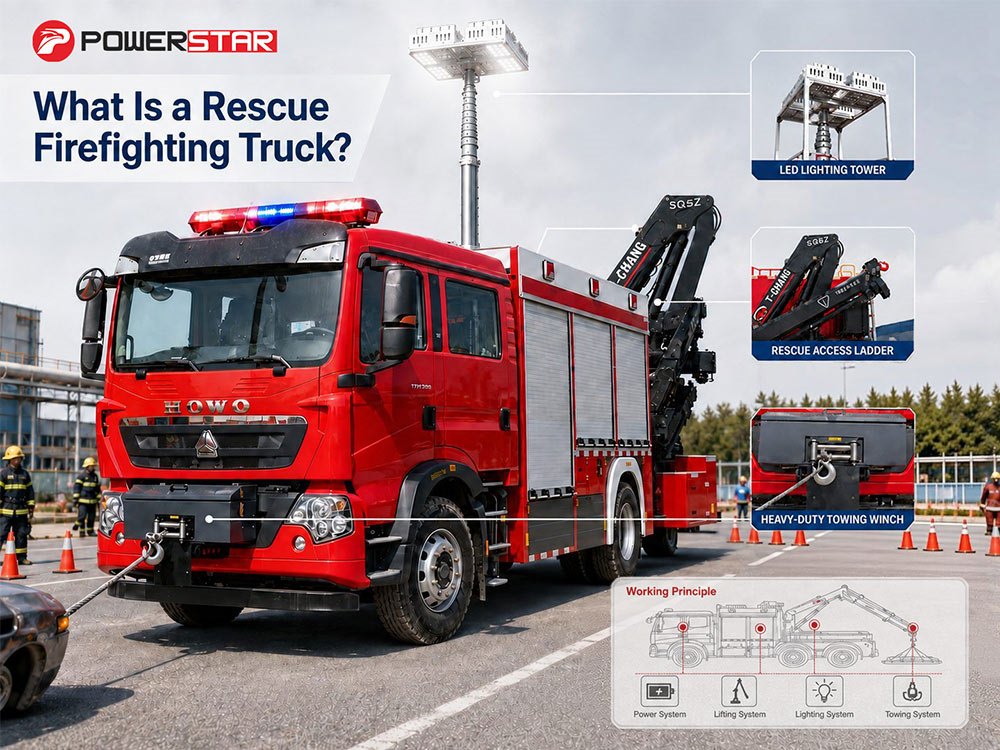
A rescue fire fighting truck is a specialized emergency vehicle designed to perform both fire suppression and rescue operations. Unlike standard fire trucks that focus primarily on extinguishing fires, rescue fire fighting trucks combine firefighting equipment with rescue tools, lifting and hoisting devices, cutting and spreading tools, winches, generators, and lighting systems. This article explains what a rescue fire fighting truck is, how it differs from other fire apparatus, what equipment it carries, and when it is deployed. I. What Is a Rescue Fire Fighting Truck? A rescue fire fighting truck is a multi-purpose emergency vehicle that combines firefighting capabilities with specialized rescue equipment. It is primarily used to provide comprehensive emergency response capability when incidents occur involving people, vehicles, buildings, or industrial facilities. Depending on the vehicle configuration, rescue fire fighting trucks can be equipped with a wide variety of rescue tools and firefighting systems. The actual equipment selection varies based on the vehicle's intended use. For example, a vehicle configured for urban rescue may have a different equipment layout than one designed for industrial rescue, earthquake response, or highway traffic accident recovery. II. What Equipment Does a Rescue Fire Fighting Truck Carry? The equipment carried on a rescue fire fighting truck depends on the vehicle's design and its intended application. However, the equipment on most models can be organized into several main categories: firefighting equipment, rescue tools, power equipment, lighting equipment, lifting and towing devices, and personal protective gear. 1. Firefighting Equipment Firefighting equipment may include fire extinguishers, fire hoses, fire nozzles, portable pumps, water tanks, foam firefighting systems, fire monitors, and other suppression tools. 2. Hydraulic Rescue Tools Hydraulic rescue tools are commonly used in traffic accident rescue operations for cutting, spreading, or lifting damaged vehicle structures. Common equipment includes hydraulic cutters, hydraulic spreaders, and hydraulic rams. 3. Power Generator Generators provide electrical power for rescue tools, lighting equipment, communication devices, and other equipment when no external power source is available at the scene. 4. Lighting Equipment Emergency lighting systems help rescue personnel operate during nighttime, inside buildings, on highways, and in other low-light conditions. 5. Winches and Towing Equipment Some rescue fire fighting trucks can be equipped with winches and towing equipment for moving damaged vehicles or handling heavy objects during rescue operations. III. Rescue Fire Fighting Truck vs Standard Fire Truck A standard fire truck is typically used primarily for fire suppression. It may be equipped with fire pumps, water tanks, foam tanks, fire hoses, fire n...
Details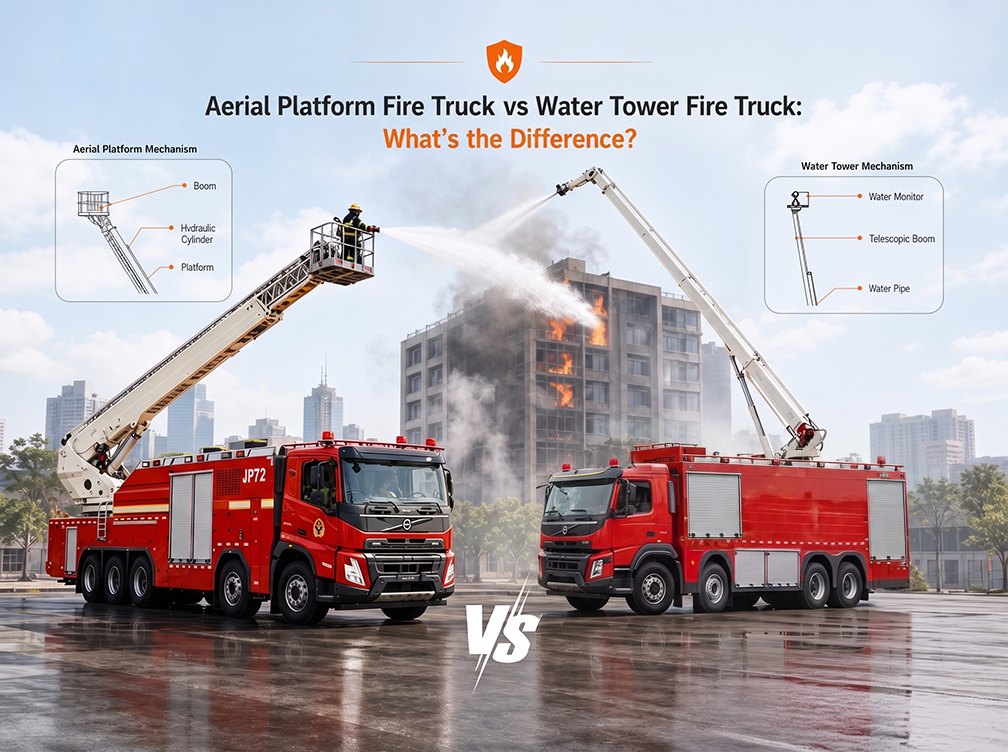
When it comes to fighting fires in high-rise buildings, industrial facilities, or large warehouses, aerial fire trucks are indispensable. But among the various types of aerial apparatus, two often cause confusion: the aerial platform fire truck and the water tower fire truck. While they may look similar at first glance—both feature hydraulic booms and are designed for elevated firefighting—they serve fundamentally different missions. This article breaks down the key differences between these two vehicle types, helping fire service professionals, procurement managers, and equipment distributors make informed decisions based on operational needs. » I. What Are Aerial Platform Trucks? An aerial platform fire truck is a specialized fire apparatus equipped with a telescopic or articulated aerial boom and a working platform, also known as a basket. The platform allows firefighters to reach elevated positions and perform rescue, firefighting, and other high-level operations. Aerial Platform Fire Truck An aerial platform fire truck is equipped with a folding or folding-telescopic combination boom, a personnel platform, a turntable, and firefighting devices. The defining feature is the work platform (bucket) at the end of the boom, where firefighters can stand to perform rescue and firefighting operations. Key characteristics:• Equipped with a platform that can carry 750 lbs to over 1,500 lbs of personnel and equipment• Designed for both rescue and firefighting—firefighters can operate directly from the platform• Platform can be used with descent control devices, hydraulic winches, or rescue chutes• Broader horizontal reach and greater working span compared to water towers » II. What Are Water Tower Fire Trucks? A water tower fire truck is an aerial firefighting vehicle designed primarily to deliver water or foam from an elevated position. Instead of carrying firefighters in a working platform, it uses an aerial boom or telescopic structure to position a high-flow fire monitor above the ground. Water Tower Fire Truck A water tower fire truck consists of a folding or folding-telescopic combination boom, a turntable, and a fire monitor mounted at the boom tip—without a personnel platform. The boom is typically constructed in multiple sections, articulated for both vertical elevation and horizontal reach. A high-flow fire monitor is fixed at the terminal end, connected to the water supply system through internal piping routed along the boom structure. The turntable supports full 360° rotation, while hydraulic cylinders control boom elevation, extension, and folding movements. Key characteristics:• No personnel platform—firefighters operate from the ground via remote control• Focused exclusively on elevated fire suppression, not rescue• Delivers exceptionally high water flow—exceeding 2,000 gallons per minute on ma...
Details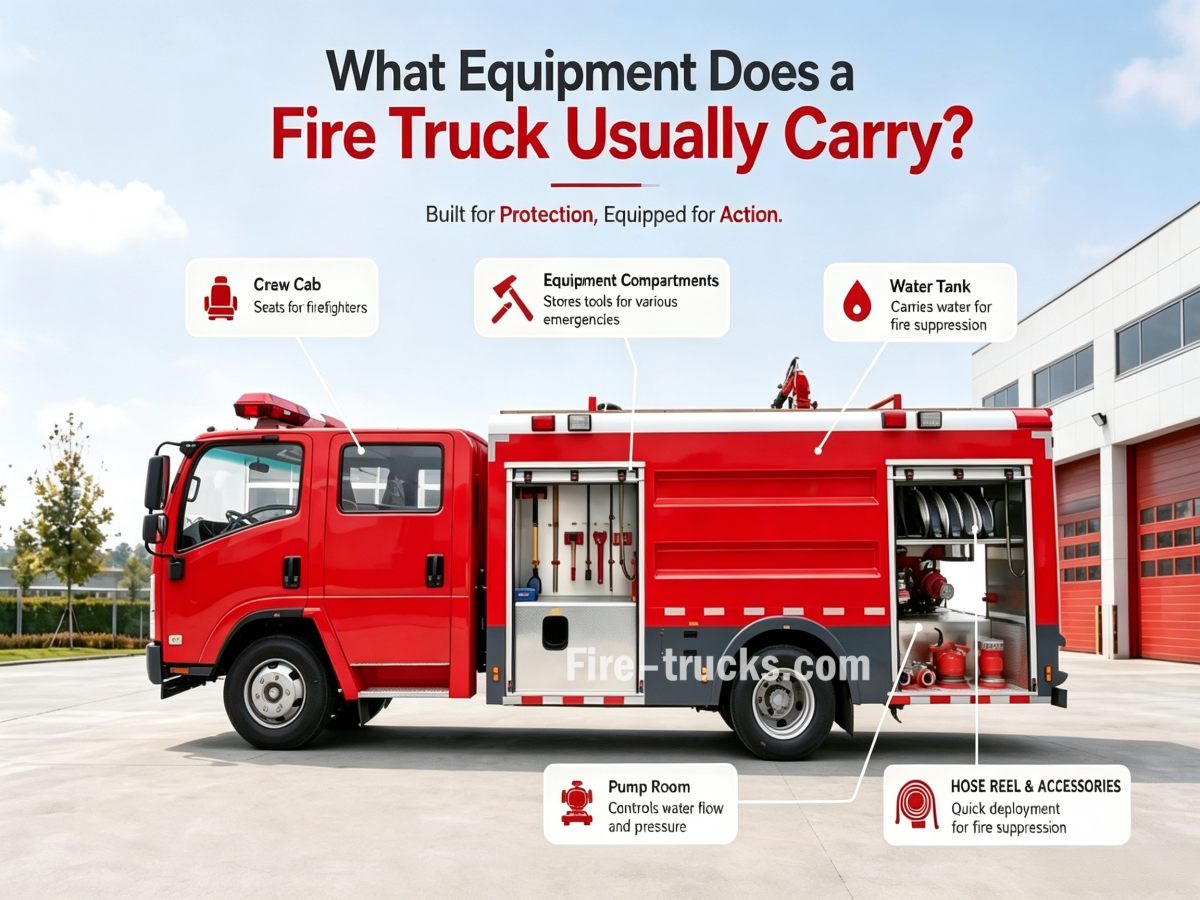
A fire truck typically carries firefighting, water supply, rescue, and safety protection equipment. Common equipment includes fire pumps, water tanks, fire hoses, fire nozzles, fire monitors, valves, fire ladders, rescue tools, protective gear, and communication devices. This article systematically breaks down the classification, functions, and selection considerations of standard fire truck equipment, helping procurement professionals and end-users build a complete understanding of fire apparatus configurations. I. Classification of Fire Truck Equipment 1. Firefighting Equipment — Core tools for direct fire suppression, including fire nozzles, fire monitors, fire hoses, water dividers, and adapters. 2. Rescue and Breaching Equipment — Tools for creating access routes for rescue and firefighting operations, including hydraulic rescue tools, fire axes, pry bars, crowbars, cut-off saws, and chain saws. 3. Rescue and Life-Saving Equipment — Equipment for search, transfer, and protection of personnel, including stretchers, rescue ropes, safety hooks, descent control devices, self-contained breathing apparatus (SCBA), and spare air cylinders. 4. Smoke Exhaust and Lighting Equipment — Equipment for improving fireground conditions, including smoke ejectors, mobile lighting towers, and portable high-intensity searchlights. 5. Personal Protective Equipment (PPE) — Gear to protect firefighter safety, including helmets, structural firefighting protective clothing, gloves, boots, and safety belts. 6. Communication and Reconnaissance Equipment — Equipment for fireground information gathering and command coordination, including two-way radios, thermal imaging cameras, and toxic gas detectors. II. Firefighting Equipment on Fire Trucks 1. Fire Pump The fire pump is the power source for all firefighting operations. It mechanically pressurizes water, giving it sufficient kinetic energy to complete the full process of "drafting → pressurizing → delivering → discharging." Typical fire pump specifications: • Standard Pressure Fire Pump (CB10/30 type): Flow rate ≥30L/s, rated pressure 1.0MPa, rear-mounted installation. Suitable for standard water tenders and foam fire trucks, meeting most urban and industrial firefighting water supply requirements. • Medium/High-Pressure Fire Pump: Low-pressure flow 30L/s at 1.0MPa, high-pressure flow 20L/s at 2.0MPa, rear-mounted installation. The dual-pressure design supports both high-volume supply (low pressure) and long-distance/high-rise delivery (high pressure) in a single pump. Ideal for urban main battle fire trucks and high-rise firefighting scenarios. • High-Pressure Fire Pump: Flow rate 10-15L/s, pressure up to 4.0MPa or higher, rear-mounted or midship-mounted. Used in high-pressure water mist systems, commonly found on airport fire trucks and specialized industrial vehicles. Complete water syste...
Details
Please subscribe latest fire trucks news, and Warmly welcome to tell us what you think.

 IPv6 network supported
Links :
ISUZU Trucks
CEEC Trucks
CS Trucks
IPv6 network supported
Links :
ISUZU Trucks
CEEC Trucks
CS Trucks

 English
 français
 Deutsch
 русский
 italiano
 español
 português
 Nederlands
 العربية
 日本語
日本語 한국의
한국의 Türkçe
 Melayu
 ไทย
ไทย Tiếng Việt
 Indonesia
  中文
中文 қазақ
қазақ Filipino
 မြန်မာ
 српски