Leave A Message
If you are interested in our products and want to know more details,please leave a message here,we will reply you as soon as we can.

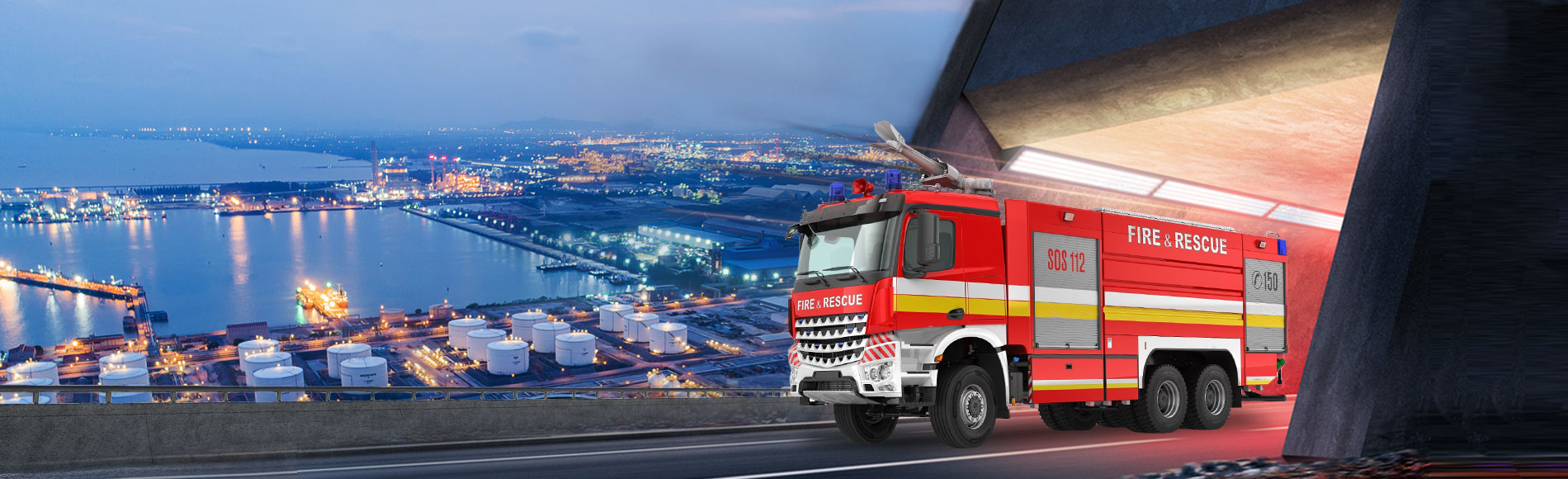
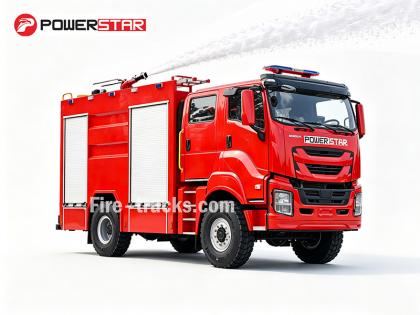
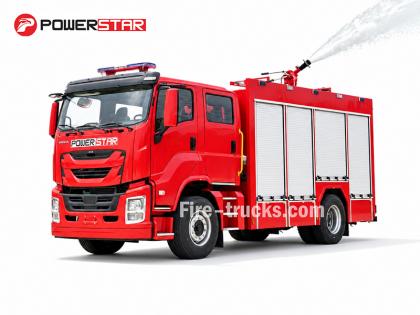
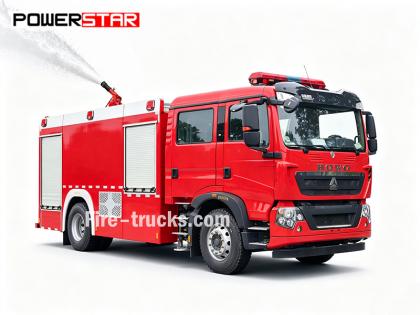
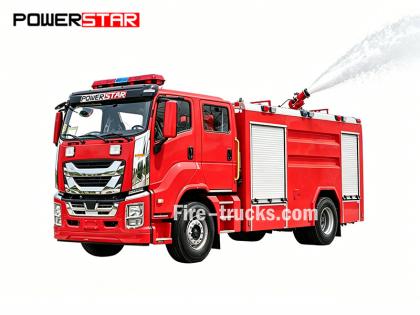
The fire truck pump and spray system is the core of firefighting operations. It acts as the "powerful arm" of the fire truck. By converting engine power into pressure (ranging from 0.8 to 1.4 MPa), it delivers extinguishing agents to heights of up to 85 meters — whether it is a high-rise building fire in a dense city center or a petrochemical storage tank fire in an industrial zone, the fire truck relies on this system to achieve effective fire suppression.
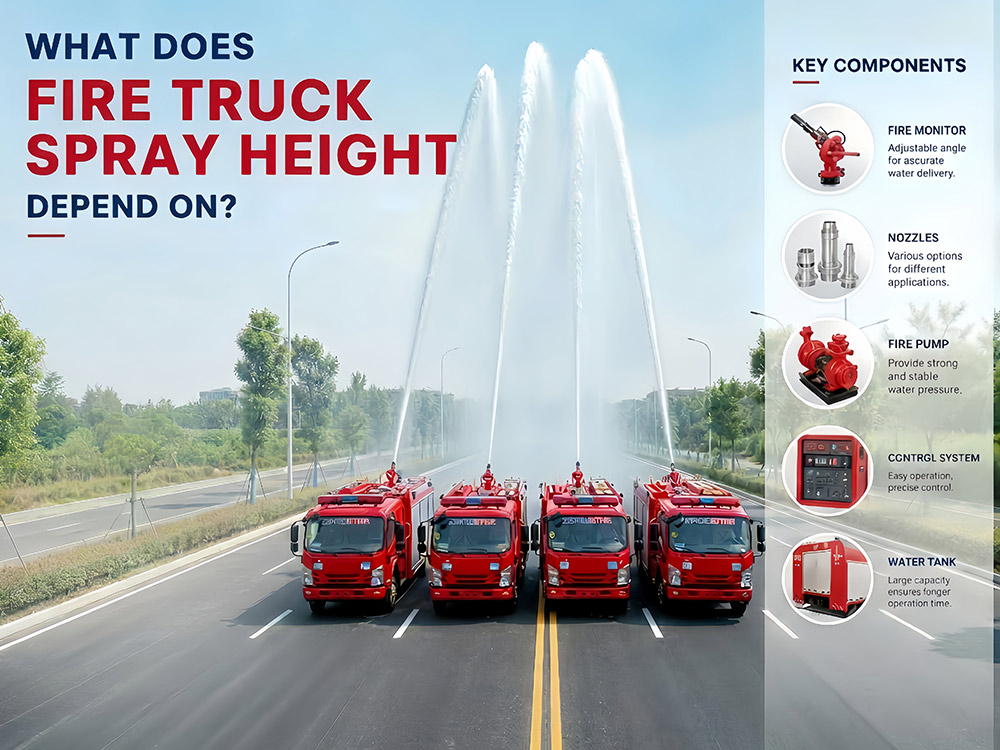
What factors affect a fire truck's spray height, and how do pump pressure, flow rate, and fire monitor work together? These are the focus of many customers. Let's learn about it today.
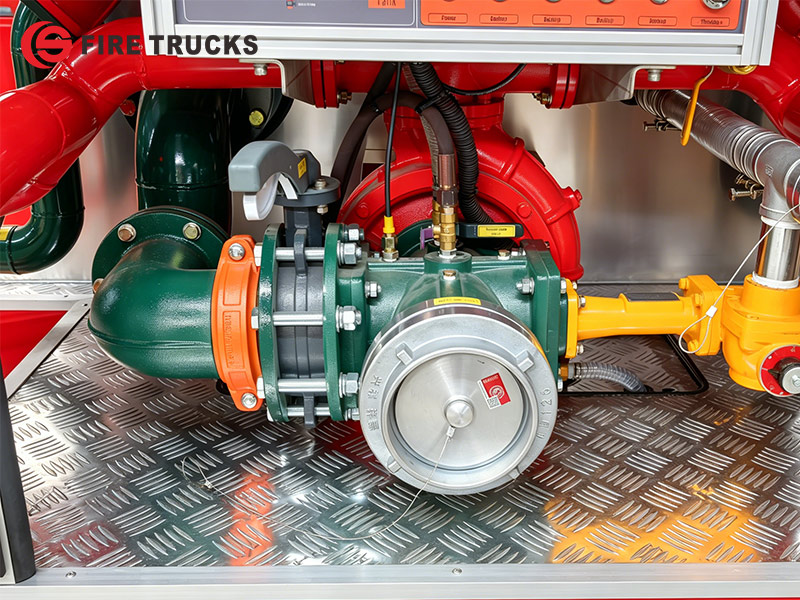
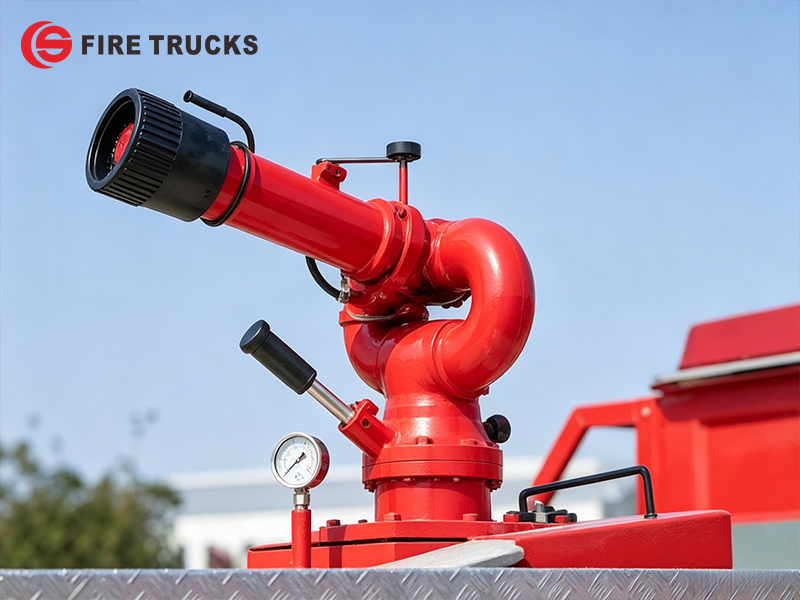
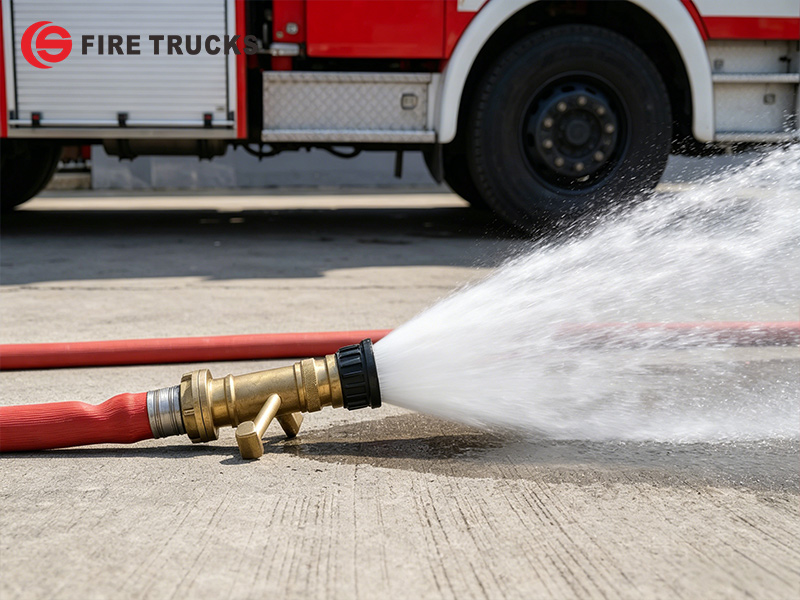
Fire truck pump pressure is the force generated by the fire pump to push the extinguishing agent through hoses and discharge it from nozzles or monitors. It is the primary driver of both flow rate and spray distance. Higher pressure produces higher velocity at the monitor outlet, directly increasing spray height. The relationship is governed by the formula H ≈ P/(ρg), where each 0.1 MPa increase adds approximately 10 meters of theoretical height — but real-world losses reduce this.
In practical firefighting operations, the following ranges apply:
| Pump Pressure | Typical Spray Height |
| 0.8 MPa | 35–45 meters |
| 1.0 MPa | 45–55 meters |
| 1.2 MPa | 55–70 meters |
| 1.4 MPa | 70–85 meters |
The pump is typically a centrifugal pump driven by the truck's engine through a power take-off (PTO). As the impeller spins, it draws the extinguishing agent in and throws it outward by centrifugal force, creating pressure that propels it through the discharge system.
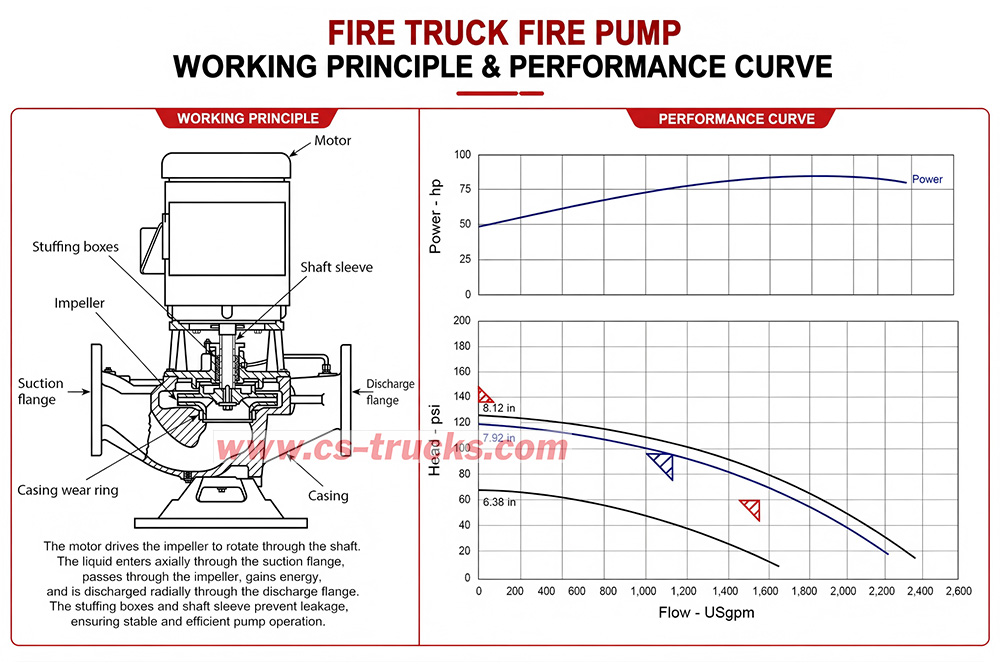 Rated Pressure vs. Operating Pressure:
| Term | Definition |
| Rated Pressure | The maximum pressure the pump can sustain continuously under design conditions |
| Operating Pressure | The actual pressure used during firefighting, typically lower than rated pressure to allow margin |
Adequate flow is as important as pressure. High pressure with low flow cannot deliver enough extinguishing agent to suppress a fire. The pump system must maintain both pressure and flow simultaneously.
Flow vs. spray height:
2,000 L/min → effective for municipal fires
3,000 L/min → suitable for industrial parks
4,000 L/min → required for petrochemical facilities
5,000+ L/min → necessary for airport crash rescue
The monitor's internal flow path, outlet diameter, and type directly affect spray height.
Monitor type comparison:
Water monitor: Highest height, straight flow path
Foam monitor: Slightly lower (5–10% less) due to air intake turbulence
Dual-purpose monitor: Moderate (compromise between water and foam)
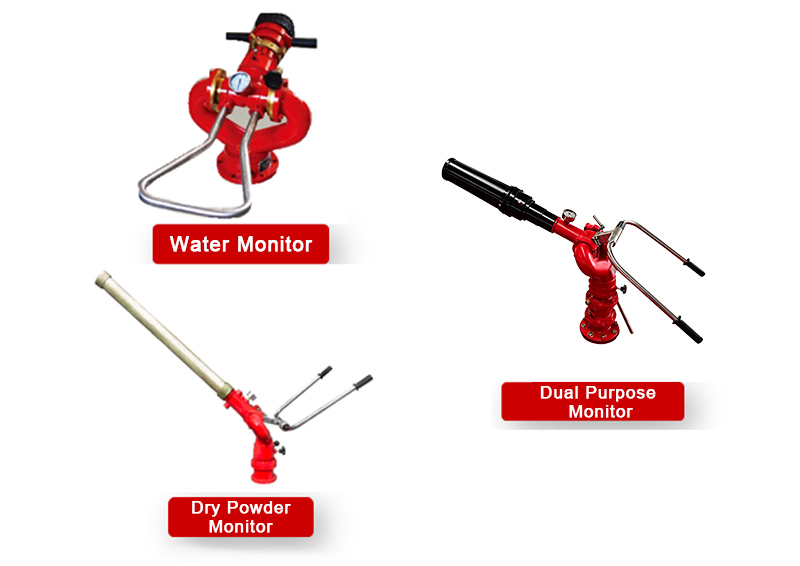
Water and foam have different densities. Foam solution is approximately 5-10% denser than water, which slightly reduces spray height at the same pressure. This should be considered when selecting equipment for foam operations.
As the extinguishing agent flows through hoses and piping, friction reduces pressure at the monitor. Longer hoses and smaller diameters increase losses.
Friction loss factors:
Hose length: Longer = more loss
Hose diameter: Smaller = more loss
Fittings and bends: Each adds resistance
To provide customers with the best firefighting solutions, FIRE TRUCKS selects the most suitable system based on application
requirements: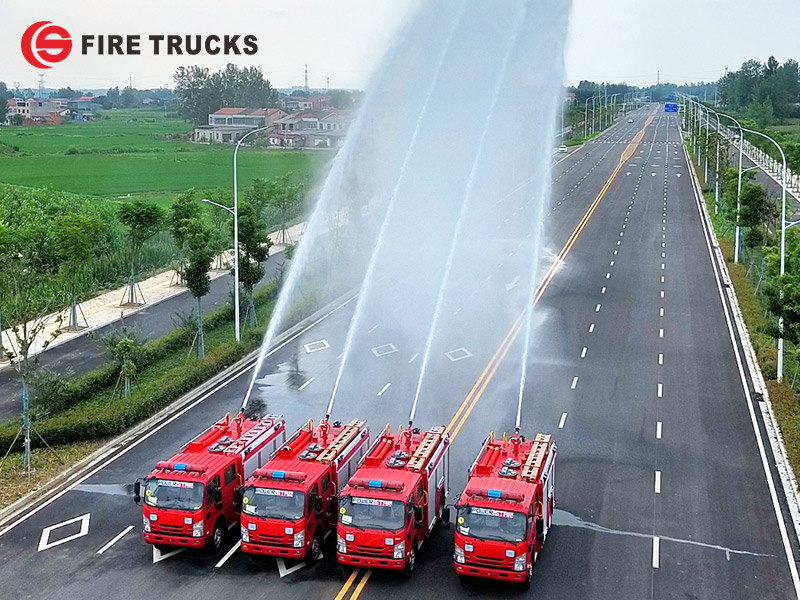
| Pump Pressure | Flow Rate | Spray Height | Recommended Application |
| 0.8 MPa | 2,000 L/min | 35–45 m | Municipal firefighting |
| 1.0 MPa | 3,000 L/min | 45–55 m | Industrial parks |
| 1.2 MPa | 4,000 L/min | 55–70 m | Petrochemical facilities |
| 1.4 MPa | 5,000+ L/min | 70–85 m | Airport firefighting |
| Application | Recommended Monitor Type | Reason |
| Municipal firefighting | Water monitor | Highest spray height, simple operation |
| Oil refinery/chemical plant | Foam monitor or dual-purpose | Handles flammable liquid fires |
| Airport crash rescue | Foam monitor (high-capacity) | Large foam volume required |
| Mixed fire risks | Dual-purpose monitor | Flexibility for both water and foam |
| Factor | Impact | How to Optimize |
| Pump pressure | Directly proportional | Select proper pressure for application |
| Flow rate | Maintains fire suppression | Balance pressure with flow |
| Monitor design | Up to 10% variation | Match monitor type to application |
| Agent type | Foam slightly reduces height | Account for density difference |
| Friction loss | Reduces effective pressure | Use shorter/larger hoses |
| Elevation gain | Consumes pressure | Add pressure for height |
| Wind speed | Reduces effective height | Position truck upwind |
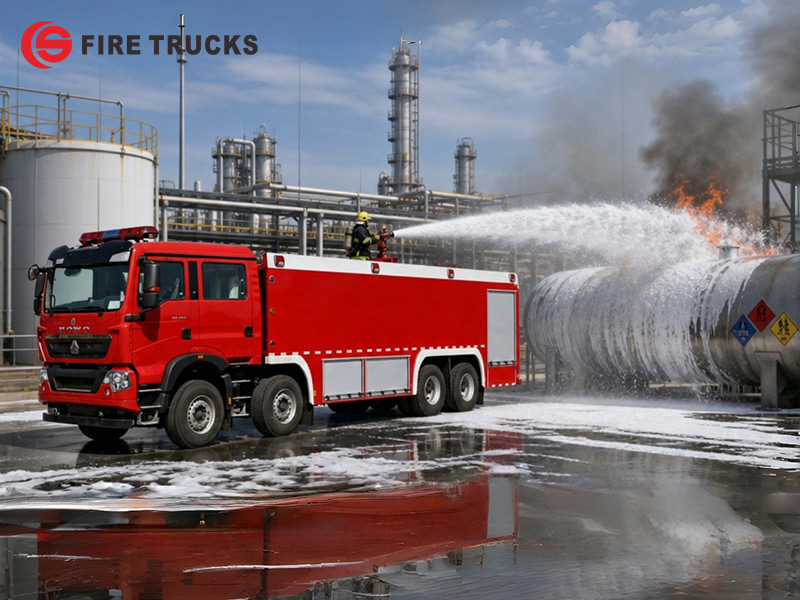
Case Background:
A large-scale fire broke out at a petrochemical storage facility in an industrial zone. The fire involved a 50-meter diameter floating roof tank containing crude oil. Ground-based hoses could not reach the fire due to the tank's height and the radiant heat zone.
Fire Truck Configuration:
8×4 foam fire truck
Pump system rated at 1.2 MPa / 4,000 L/min
PL48 foam/water dual-purpose monitor
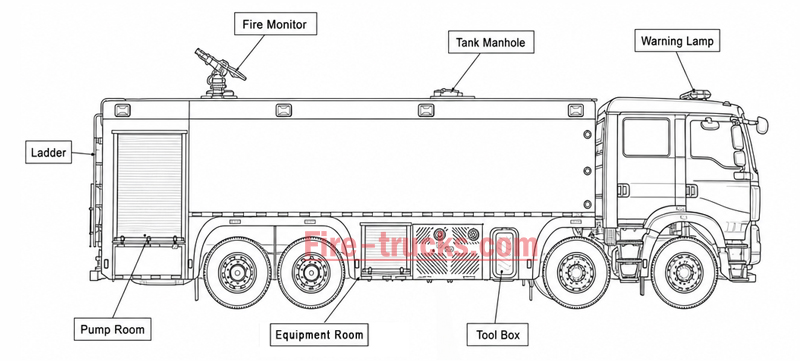
Actual Performance:
Measured spray height: approximately 62 meters
Effective coverage: tank area of approximately 80 meters in diameter
Foam blanket successfully suppressed the fire within 8 minutes
Key Lesson:
For large storage tank fires, pressures below 1.0 MPa are often insufficient to deliver foam over the required distance. The combination of adequate pressure, high flow rate, and a properly selected monitor is essential for effective fire suppression.
Misconception 1: Higher pressure is always better
Reality: Higher pressure increases energy consumption, equipment cost, and maintenance complexity. Excessive pressure can also damage hoses and nozzles. The goal is adequate pressure for the job, not maximum pressure.
Misconception 2: Spray height equals firefighting capability
Reality: Flow rate is often more critical than height. A high stream at low flow may not deliver enough extinguishing agent to suppress a fire. The combined value of pressure and flow is what matters.
Misconception 3: Friction loss can be ignored
Reality: Over long hose lays, friction loss can consume 20-30% of the pump's pressure. Proper calculation of friction loss is essential to ensure adequate pressure at the nozzle.
Misconception 4: The monitor makes no difference
Reality: A high-pressure pump connected to a poorly designed monitor will not achieve maximum spray height. The monitor's internal flow path, outlet diameter, and type all affect final performance. Matching the monitor to the pump is as important as selecting the pump itself.
Q: What is the most common pump pressure on fire trucks?
A: Most fire trucks are designed with pump pressures ranging from 0.8 to 1.2 MPa, with 1.0 MPa being the most common standard.
Q: How high can a 1.0 MPa pump spray?
A: Under standard conditions, a 1.0 MPa pump can achieve spray heights of 45 to 55 meters using a medium to large monitor.
Q: Why do high-rise fires require higher pump pressure?
A: High-rise fires require additional pressure to overcome elevation gain (1.0 m of height requires approximately 0.01 MPa) and friction loss in vertical hose lines.
Q: Does a foam monitor achieve the same spray height as a water monitor?
A: Typically, foam monitors achieve slightly lower heights (5-10% less) than water monitors at the same pressure due to the air intake design that creates turbulence and the higher density of foam solution.
Q: What is the most important factor for spray height?
A: No single factor determines spray height. Pump pressure, flow rate, monitor design, nozzle type, and environmental conditions all work together. A well-balanced system is more effective than one that excels in only one area.
Q: Does the monitor itself affect spray height?
A: Yes. The monitor's internal flow path, outlet diameter, and type (water, foam, or dual-purpose) all directly affect spray height. A well-designed monitor maximizes the energy delivered by the pump.
Spray height depends on multiple factors — pump pressure, flow rate, monitor design, agent type, friction loss, elevation, and wind conditions
1.0–1.2 MPa is the mainstream pressure range for most industrial firefighting applications
Monitor selection matters — a high-pressure pump with a poorly designed monitor will not achieve maximum spray height
Flow rate is as important as pressure — high pressure with low flow may not deliver enough extinguishing agent to suppress a fire
Different agents have different spray characteristics — foam is denser and achieves slightly lower height
Petrochemical and airport projects typically require 1.2 MPa or higher
For international projects, prioritize fire trucks that comply with recognized standards such as NFPA, EN, or GB
Fire truck spray height is not determined by a single factor. It depends on the combined effect of pump pressure, flow rate, monitor design, agent type, friction loss, elevation gain, and wind conditions.


You may be interested in the following information
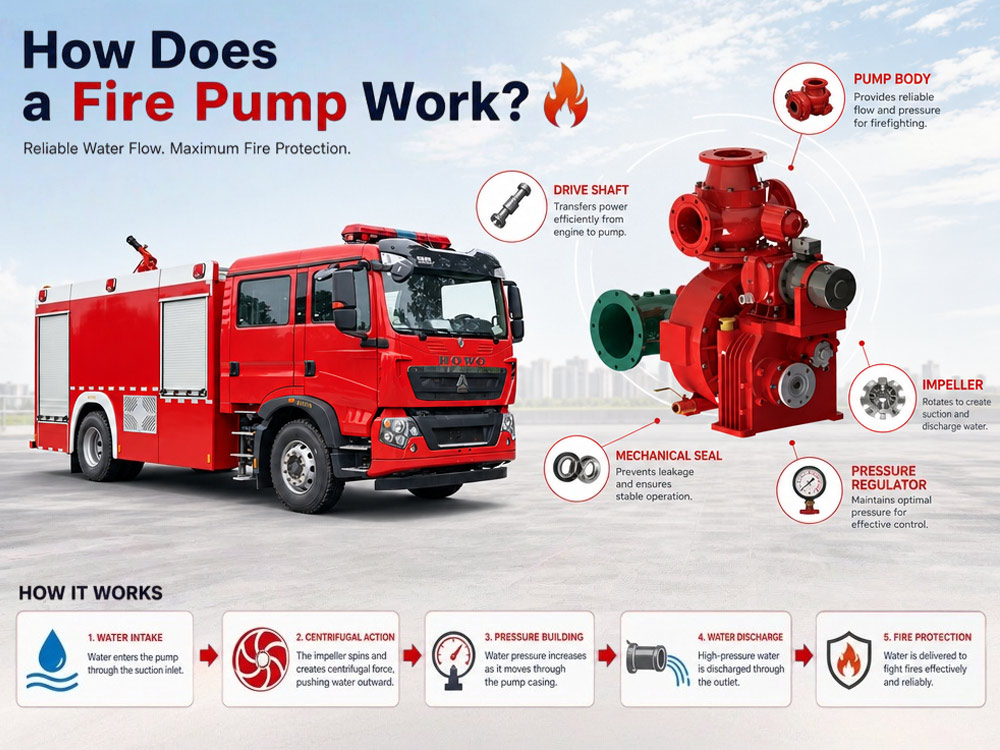
A fire pump is the heart of every fire truck's water delivery system. Whether responding to a structural fire, industrial emergency, airport incident, or wildland operation, the fire pump on a fire truck is responsible for delivering high-pressure water to hoses, fire monitors, and foam systems. Its centrifugal impeller design and PTO-driven system ensure stable pressure and high flow rates, directly increasing firefighting effectiveness by over 40%, while reducing response time by 3 times. It can be called the invisible guardian of firefighting operations and the technical cornerstone of modern emergency response. Learn how a fire pump works, including its working principle, major components, water flow process, pressure generation, and applications. Discover how fire truck pumps deliver reliable water supply for firefighting and how to choose the right pump for your fire apparatus. Let's learn about it today. » I. First, we need to know the three key components of the fire pump system: 1.Impeller The rotating component that draws water in and throws it outward by centrifugal force. Typically made of bronze, stainless steel, or cast iron. 2.Pump casing The housing that contains the impeller and directs water flow. Designed to convert velocity into pressure. 3.Power Take-Off (PTO) The mechanical connection that transfers engine power from the truck's transmission to the fire pump. » II. After knowing the key components, the core working principle of the fire pump is as follows: 1. Power is transferred from the engine through the PTO The truck engine drives the PTO, which connects to the pump shaft. When the operator engages the PTO, engine power is redirected to spin the pump impeller at high speed. 2. The impeller begins rotating The impeller spins at 1,500–2,500 RPM, drawing water into the pump through the suction inlet. The spinning impeller blades create a low-pressure zone at the center, pulling water in from the onboard tank, hydrant, or natural water source. 3. Centrifugal force increases water pressure As the impeller spins, it throws water outward by centrifugal force. The water's velocity increases as it moves from the center to the outer edge of the impeller. The pump casing then converts this velocity into pressure, forcing high-pressure water out through the discharge outlet. 4. High-pressure water exits the discharge outlet Pressurized water (typically 0.8–1.2 MPa) exits through the discharge outlet and is delivered to fire hoses, fire monitors, or foam proportioning systems for firefighting operations. » III. Where does the fire pump get water? The fire pump can draw water from three sources: Onboard water tank: The primary water source for initial attack. Typical capacity: 2,000–12,000 liters. Provides immediate water supply upon arrival. Fire hydrant: Connected through supply hoses. Provides continuous water supply for extended operations. Pressure from hydrant helps the pum...
Details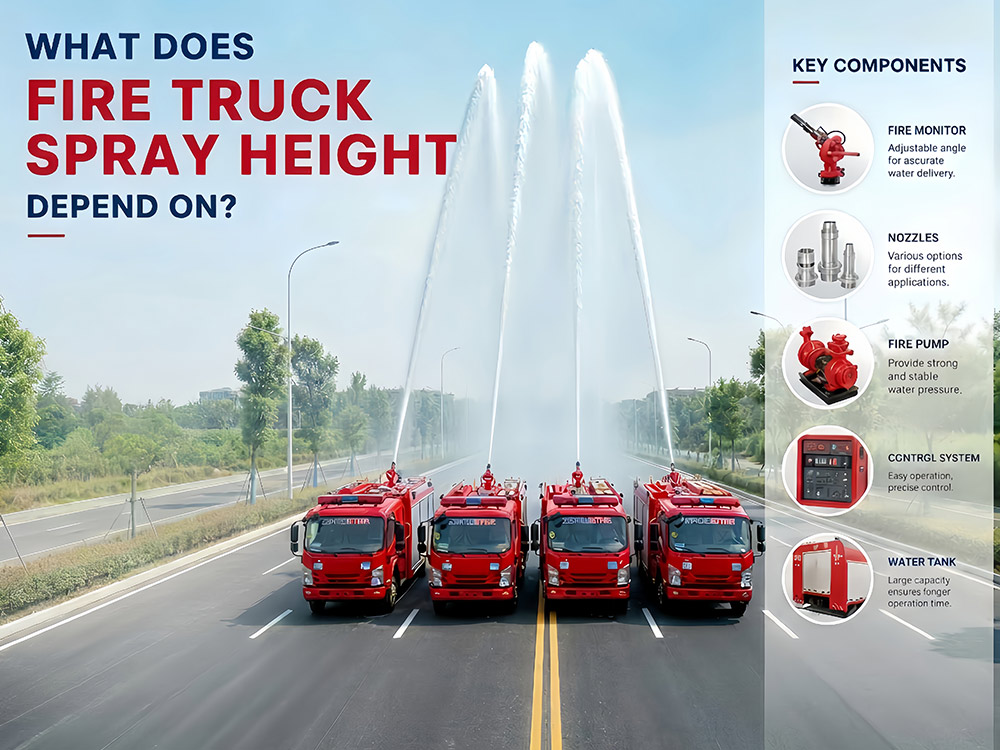
The fire truck pump and spray system is the core of firefighting operations. It acts as the "powerful arm" of the fire truck. By converting engine power into pressure (ranging from 0.8 to 1.4 MPa), it delivers extinguishing agents to heights of up to 85 meters — whether it is a high-rise building fire in a dense city center or a petrochemical storage tank fire in an industrial zone, the fire truck relies on this system to achieve effective fire suppression. What factors affect a fire truck's spray height, and how do pump pressure, flow rate, and fire monitor work together? These are the focus of many customers. Let's learn about it today. » I. Three Key Components That Determine Spray Height 1. Fire pump system: The heart of the fire truck. Centrifugal pump driven by PTO. Common pressure grades: 0.8 MPa, 1.0 MPa, 1.2 MPa, 1.4 MPa. Flow rates from 2,000 to 5,000+ L/min. 2.Fire monitor: The final component before the extinguishing agent leaves the truck. Available in water monitor, foam monitor, and dual-purpose monitor. PL-series (PL48) with flow rates up to 4,000 L/min and spray height up to 70+ meters. 3. Delivery system: Piping, hoses, and nozzles that carry the extinguishing agent from the pump to the monitor. Hose diameter, length, and nozzle type all affect final spray height. » II. Core Factors That Determine Spray Height 1.1. Pump Pressure Fire truck pump pressure is the force generated by the fire pump to push the extinguishing agent through hoses and discharge it from nozzles or monitors. It is the primary driver of both flow rate and spray distance. Higher pressure produces higher velocity at the monitor outlet, directly increasing spray height. The relationship is governed by the formula H ≈ P/(ρg), where each 0.1 MPa increase adds approximately 10 meters of theoretical height — but real-world losses reduce this. In practical firefighting operations, the following ranges apply: Pump Pressure Typical Spray Height 0.8 MPa 35–45 meters 1.0 MPa 45–55 meters 1.2 MPa 55–70 meters 1.4 MPa 70–85 meters 1.2. How the fire pump works: The pump is typically a centrifugal pump driven by the truck's engine through a power take-off (PTO). As the impeller spins, it draws the extinguishing agent in and throws it outward by centrifugal force, creating pressure that propels it through the discharge system. Rated Pressure vs. Operating Pressure: Term Definition Rated Pressure The maximum pressure the pump can sustain continuously under design conditions Operating Pressure The actual pressure used during firefighting, typically lower than rated pressure to allow margin 2. Flow Rate (L/min) Adequate flow is as important as pressure. High pressure with low flow cannot deliver enough extinguishing agent to suppress a fire. The pump system must maintain both pressure and flow simultaneously. Flow vs. spray height: 2,000 L/min → effective for municipal fires 3,000 L/min → suitable...
Details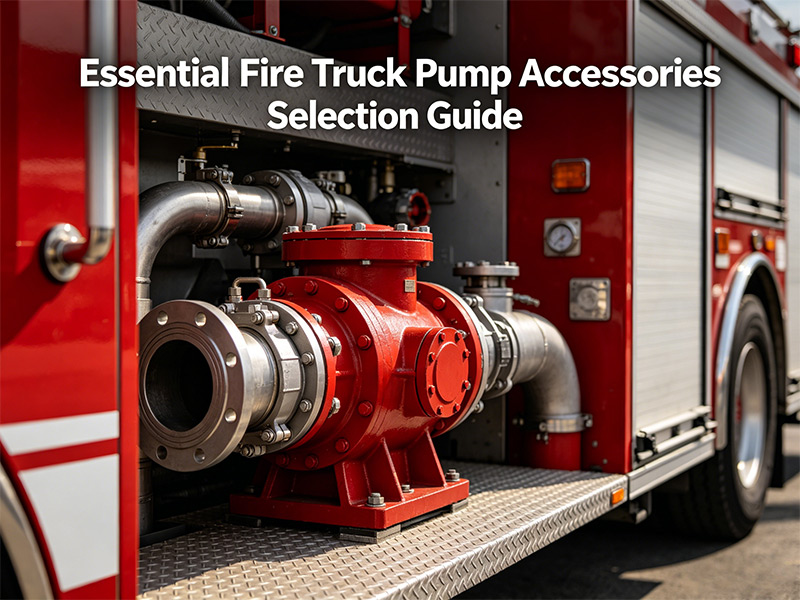
A fire truck pump system is only as reliable as its components. From drawing water from a source to discharging it at high pressure, every accessory plays a critical role. This guide covers fire truck five key accessory categories: primers, ball valves, globe valves, foam proportioners, and hydraulic control systems. Understanding these components helps firefighters maintain their equipment and choose the right accessories for specific applications. I. Primer Series (Vacuum Priming Devices) Primers are essential for drawing water from lakes, rivers, or other static sources when a hydrant is not available. They remove air from the pump and suction hose, allowing atmospheric pressure to push water into the pump. Product Overview Product Max Vacuum Voltage Power Suitable Pump Size 2-piston primer >85kPa 24V - Below 100 L/s Electric 2-piston primer >85kPa 24V 2.1KW Below 100 L/s 4-piston primer >85kPa 24V - Above 100 L/s Electric 4-piston primer >85kPa 24V 2.1KW Above 100 L/s Key Feature: Electric Primers Electric primers offer a significant advantage — they can prime the pump without the pump rotating. This protects the mechanical seal from dry running damage. When a standard primer requires the pump to spin, the electric version works independently, extending seal life. II. Ball Valve Series (Flow Control) Ball valves control water flow through hoses and discharge outlets. They are designed for quick on/off operation with a simple 90° turn. Stainless Steel Ball Valves Model Material Rated Pressure Thread Operation FQS65/2.5 Body & ball: 304 stainless steel; Seal: PTFE 2.5 MPa G2-1/2" Handwheel / Lever FQS80/2.5 Body & ball: 304 stainless steel; Seal: PTFE 2.5 MPa G3" Handwheel / Lever Aluminum Alloy Ball Valves (Lighter weight) Model Material Rated Pressure Thread Operation FQS65/2.5 Body: A356.2; Ball: 304; Seal: PTFE 2.5 MPa G2.5" Handwheel / Lever FQS80/1.6 Body: A356.2; Ball: 304; Seal: PTFE 1.6 MPa G3" Handwheel / Lever FQS65/2.5 Square Body: A356.2; Ball: 304; Seal: PTFE 2.5 MPa - Pneumatic / Lever Ⅲ. Globe Valve Series (Pressure & Flow Regulation) Unlike ball valves that are designed for on/off operation, globe valves allow precise control of flow rate and pressure. They are ideal for situations where gradual adjustment is needed. Model Material Rated Pressure Thread Operation DN65/2.5 Body: A356.2; Stem: H62; Seal: NBR 2.5 MPa G2.5" Handwheel DN80/2.5 Body: A356.2; Stem: H62; Seal: NBR 2.5 MPa G3" Handwheel When to Use a Globe Valve Use globe valves at discharge points where fine pressure control is required, such as when filling another vehicle's tank or supplying a hose line at a specific pressure. IV. Foam Proportioner Series (Foam Mixing Equipment) Foam proportioners mix foam concentrate with water at precise ratios. This is essential for fighting Class B (flammable liquid) fires where water alone is ineffective. Ma...
Details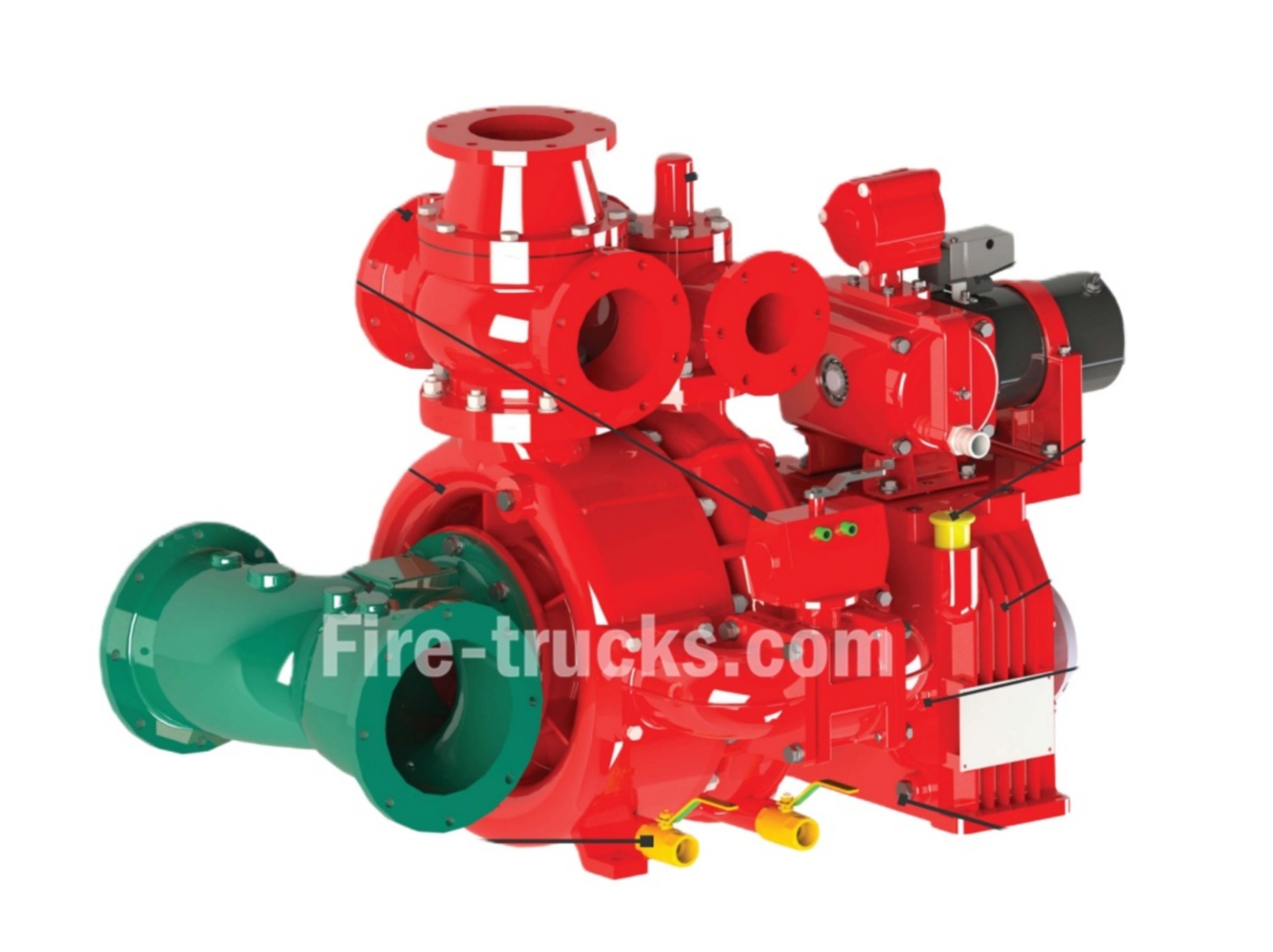
As a professional xiongzhen fire pump manufacturer in china, Powerstar Trucks owns its own brand "Xiongzhen" series of products, including low-pressure fire pump, medium-low-pressure fire pump, and high-low-pressure vehicle-mounted fire pumps, as well as supporting equipment such as fire monitors and foam proportioners. Its fire pumps utilize new materials such as aluminum alloy and stainless steel, and are equipped with an electromagnetic clutch automatic disengagement device and a check valve, featuring excellent performance, simple operation, and convenient maintenance. The company's products have passed type testing by the National Fire Equipment Quality Supervision and Inspection Center, CCC certification, and ISO9001 quality management system certification. Xiongzhen fire pumps mainly include the following models: CB10/20-XZ, CB10/30-XZ, CB10/40-XZ, CB10/60-XZ, CB10/80-XZ, CB10/100-XZ, CB20.10/15.30-XZ, CB20.10/20.40-XZ, CB20.10/30.60-XZ, etc. FIRE PUMP CB10/20-XZ for fire trucks FIRE PUMPS CB10/30-XZ for fire trucks Fire pumps Model CB10/40-XZ for fire engine China Fire pumps Model CB10-60 for fire rescue trucks Emergency Fire Pumps CB10/80-XZ for fire engine trucks fire fighting Pumps CB10/100-XZ for fire vehicle xiongzhen Fire Pump System CB10/100-XZ Specification xiongzhen CB series Fire Pump Manufacturers Fire Pumps Sets CB10/150 Specifications Fire Fighting Pump System CB10/160-XZ xiongzhen factory Emergency Fire Pumps CB10/170-XZ specifications Powerstar trucks boasts strong technical capabilities, holding four patents, and utilizes advanced production equipment such as CAD drafting and CNC machine tools to ensure high product qualification rates and customer satisfaction. Its products are primarily targeted at fire truck modification plants and fire brigades. CB20.10 20.40 fire pump details specificaiton Fire Pump CB20.10 30.60-XZ by xiongzhen factory Fire pump CB20/15-XZ series emergency fire pump CB20/20-XZ series Fire Pump Installation CB20 25 details Here's a maintenance schedule for your XIONGZHEN fire pumps, categorized by week, month, quarter, and year for easy reference: 01, Powersar Fire pump Daily Inspection: Check the start-stop pressure and frequency of the pressure-stabilizing pump. Check the starting battery power of the diesel engine fire pump. Check the appearance of the water source control valves and alarm valve assemblies for damage. 02, Powersar Fire pump Weekly Inspection: Test run the automatic start motor fire pump. Check the fuel level of the diesel engine fire pump. 03, Powersar Fire pump Monthly Inspection: Test run the manual start motor fire pump and diesel engine fire pump. Check the water level of the fire water tank and elevated fire water tank. Check the air pressure, water level, and effective volume of the pressure tank. Check t...
Details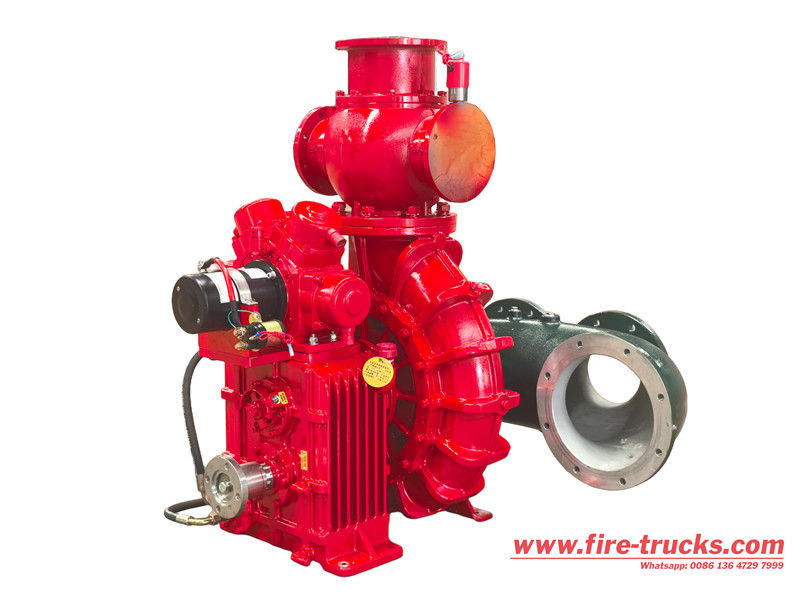
The CB10/140 foam fire fighting pump is a commonly used vehicle-mounted or stationary fire water supply system with a rated pressure of 1.0 MPa and a rated flow rate of 140 L/s, meeting the core water supply needs of firefighting systems. The pump body and impeller are constructed of high-quality, wear-resistant materials, offering corrosion resistance and high-pressure resistance. It features a dual-inlet design for rapid water source switching and is driven by a high-efficiency motor or diesel engine, achieving a startup response time of 30 seconds or less. With its compact design, easy maintenance, and reliable operation, the CB10/140 foam fire fighting pump is a vital piece of equipment for ensuring efficient water supply for firefighting operations. The CB10/140-XZ low-pressure truck-mounted fire pump features a single-stage centrifugal structure with an aluminum alloy pump casing and a brass impeller. It utilizes an electric four-piston water priming system with electric switching. The optional CB10/20 foam pump utilizes a pneumatic separation mechanism. This product offers excellent performance, a compact structure, simple operation, and easy maintenance. The CB10/140-XZ fire pump is a single-stage centrifugal water pump used in fire trucks, characterized by its two-piston priming device that automatically engages and disengages. It is designed for high performance with a compact structure, easy operation, and convenient maintenance. Key specifications include a flow rate of \(140\) L/s and an outlet pressure of \(1.0\) MPa at a rated speed of \(2600) r/min. ». Working principle of CB10/140 foam fire fighting pump ●Water and foam concentrate intake: Water is drawn from a supply, and foam concentrate is drawn from its storage tank. ●Proportioning: The proportioner mixes the foam concentrate with the water at a predetermined ratio. ●Pressurization: The pump pressurizes the mixture, increasing its velocity and pressure. ●Discharge: The pressurized foam solution is pushed through the discharge hose to the nozzle, where it is discharged onto the fire. ●Fire suppression: The foam blankets the fuel source, separating it from oxygen and extinguishing the fire. ». Detailed introduction of CB10/140 foam fire fighting pump 1. Superior Structural Design, Stable and Reliable Performance: ●The CB10/140 fire pump features a single-stage centrifugal design and is constructed from high-strength aluminum alloy, offering advantages such as light weight, corrosion resistance, and high-temperature resistance. ●The pump's internal structure is precision-machined, ensuring smooth flow and excellent hydraulic performance. A mechanical seal prevents leaks and ensures long-term operational reliability. ●This fire pump boasts powerful suction and discharge capacities, making it suitable for a variety of medium- and large-sized firefighting vehicles and emergency firefighting equipment. 2. Easy Oper...
Details
Please subscribe latest fire trucks news, and Warmly welcome to tell us what you think.

 IPv6 network supported
Links :
ISUZU Trucks
CEEC Trucks
CS Trucks
IPv6 network supported
Links :
ISUZU Trucks
CEEC Trucks
CS Trucks

 English
 français
 Deutsch
 русский
 italiano
 español
 português
 Nederlands
 العربية
 日本語
日本語 한국의
한국의 Türkçe
 Melayu
 ไทย
ไทย Tiếng Việt
 Indonesia
  中文
中文 қазақ
қазақ Filipino
 မြန်မာ
 српски