Leave A Message
If you are interested in our products and want to know more details,please leave a message here,we will reply you as soon as we can.

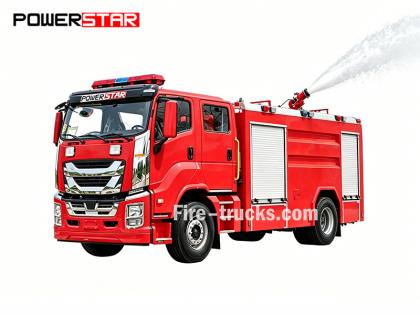
The PF5-15 fixed dry powder monitor uses dry powder as the medium and relies on a fixed base for stable spraying. It is suitable for chemical and warehouse areas, and can quickly cover the burning surface in the early stages of a fire, improving extinguishing efficiency.
The PF5-15 fixed dry powder monitor has a robust structure, is easy to operate, and can be linked with an automatic control system for remote activation and precise spraying.

» Ⅰ. PF5-15 fixed dry powder monitor structure:


Features of the PF5-15 fixed dry powder monitor:
● Fully functional;
● Simple and novel structure;
● Stable performance and easy maintenance;
● Low inlet pressure;
● Equipped with an automatic drain valve with horizontal and vertical locking functions;
● Material: Precision cast aluminum alloy;
● Cannon head: Aluminum alloy.

» Ⅱ. Foam Cannon PL24 specifications:
|
Model |
Flow |
Range(m) |
Rated working pressure(Mpa) |
Pitch rotation |
Horizontal rotation |
L×W×H |
Weight |
|
PF5-15/40 |
40 |
≥42 |
0.80 |
-45~+70 |
0~360 |
980x340x550 |
28.5 |

» Ⅲ.Product Applications:
 |
 |
| Fire truck with PF5-15 fixed dry powder monitor | PF5-15 fixed dry powder monitor testing |
The PF5-15 fixed dry powder monitor has a long spray distance and wide coverage, and can quickly form a dry powder fire extinguishing barrier. It is suitable for fixed locations such as chemical plants, oil depots, and storage areas, providing continuous and stable fire extinguishing capabilities for large areas.


You may be interested in the following information
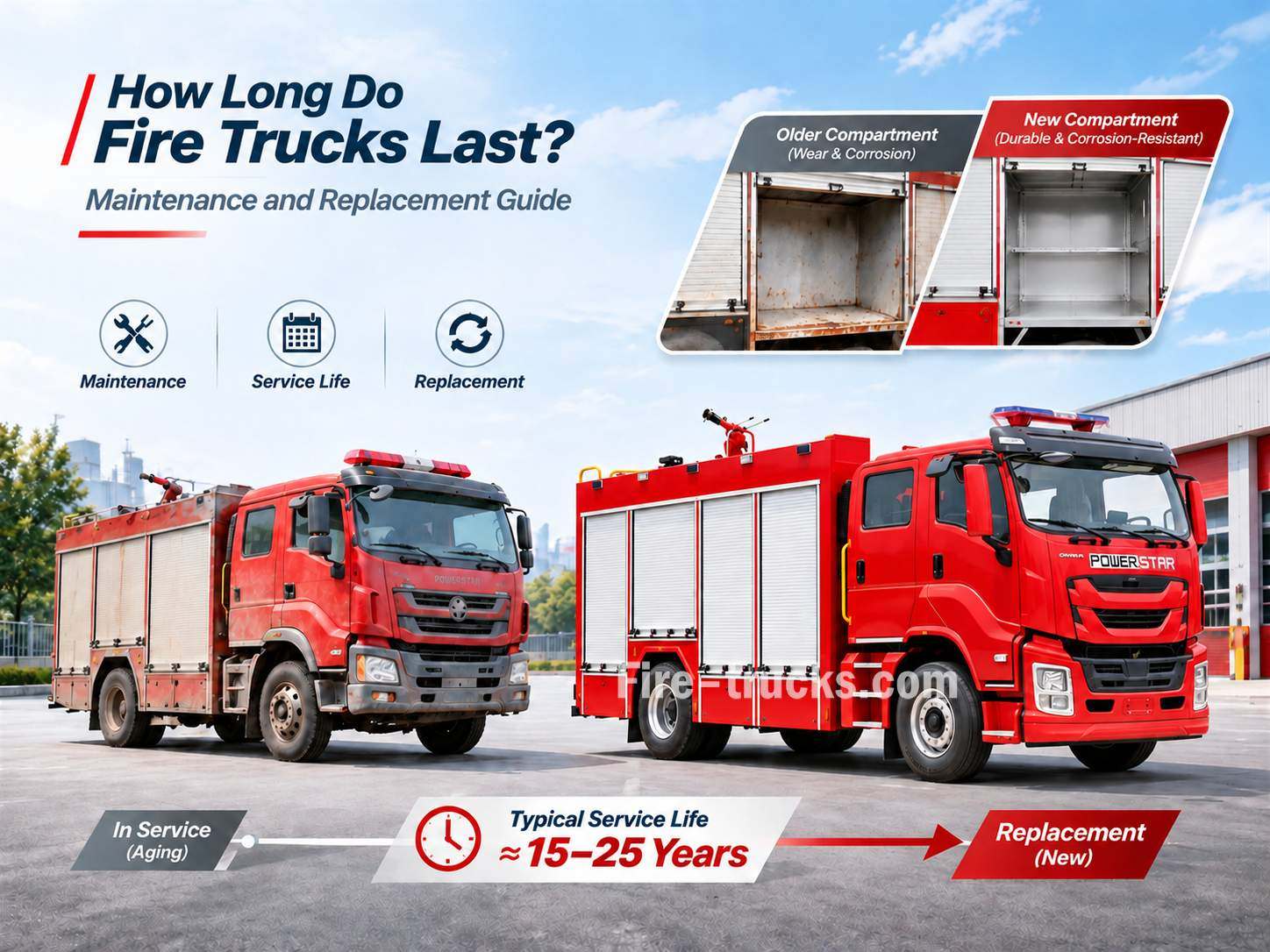
A fire truck is a specialized emergency vehicle that needs to operate in harsh working environments. It not only needs to respond quickly to emergency tasks, but also needs to carry a large amount of equipment, transport water or fire extinguishing agents, and maintain reliable working performance in complex environments. However, like other commercial vehicles, fire trucks have a certain lifespan. Its actual service life depends on the quality of the chassis, operating environment, annual mileage, maintenance practices, and the overall condition of critical fire protection systems. So, how long can a fire truck be used? There is no uniform replacement period that applies to all fire engines. A well-maintained vehicle may continue to serve for many years, while a vehicle that frequently performs emergency missions, is exposed to harsh environments for a long time, or lacks maintenance may need to be replaced sooner. This article will look at the main factors that affect the service life of a fire truck, how to extend the life of your vehicle through proper maintenance, and what signs you should consider replacing an older fire truck. Quick Answer: How many years does a fire truck last? The service life of a fire truck can usually be quoted as 10–20 years or more, but it depends on the model, work intensity, usage environment, maintenance records and the overall condition of the vehicle. In practice, a well-maintained fire truck with an intact chassis can operate for more than 25 years, while a fire truck with severe corrosion or outdated parts may need to be replaced sooner. » I. How Long Does a Fire Truck Usually Last? The life of a fire truck is usually divided into two stages: Front-line service (10-15 years): As the primary response unit, vehicles face high police traffic, heavy pumping operations, and daily wear and tear. Reserve duty (15-25 years): The vehicle is transferred to reserve duty or low-intensity police service to extend its service life. » II. Which Components Affect Fire Truck Service Life? Fire trucks age because their core components wear out. The service life depends on the weakest link in the mechanical chain. Component What Determines Its Lifespan Chassis Load-bearing capacity, frame strength, corrosion Engine Wear, cooling efficiency, operating hours Fire Pump Impeller wear, mechanical seal integrity, bearing condition Water Tank Corrosion resistance, baffle integrity, weld quality Electrical System Wiring integrity, controller reliability, sensor accuracy Impact of working conditions: Two fire trucks built in the same year can have very different lifespans depending on how and where they are used. Five key factors determine this: ♦ Operating hours: High operating levels and long pump operations will accelerate engine and water pump wear. ♦ Road Conditions: Rough terrain and unpaved roads can cause stress on the chassis, suspension...
Details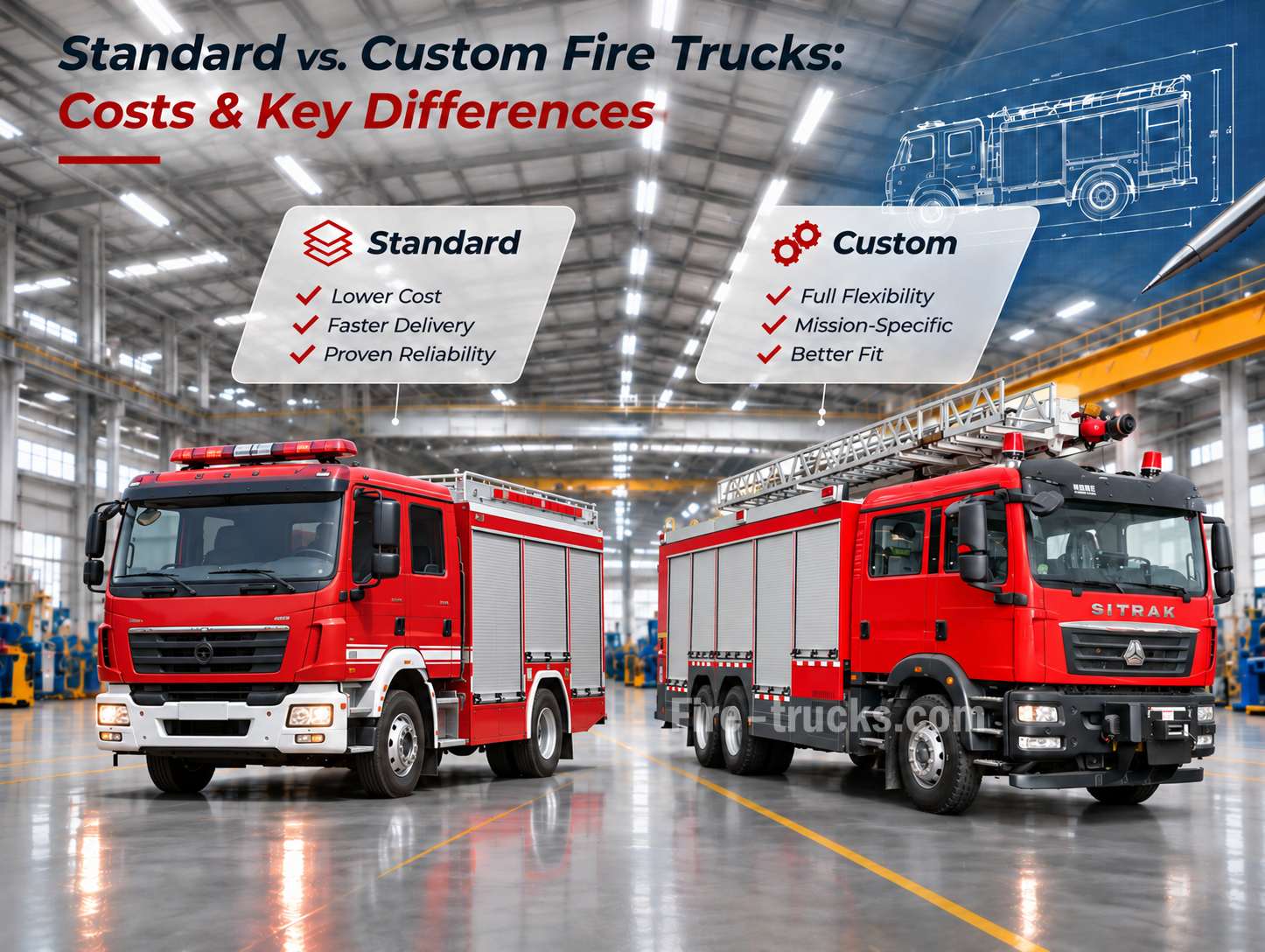
Choosing the right fire truck is a critical decision for any fire department, emergency rescue agency, or government procurement unit. Purchasers frequently face a key question: should they buy a standardized fire truck or invest in a custom build? Both options have advantages and limitations. The final choice depends on the fire department's actual operational needs, working environment, budget, equipment configuration requirements, and long-term maintenance plans. This article explains the main differences between standardized and custom fire trucks, compares their respective advantages, and outlines the key factors to consider before purchasing a fire truck. Quick Answer Standardized fire trucks are pre-engineered models built to established configurations with limited customization options. They offer lower costs, faster delivery, and proven reliability. Custom fire trucks are designed from the ground up to meet a department's exact specifications, offering maximum flexibility and fit but requiring a higher upfront investment and significantly longer lead times. The right choice depends on whether your operational needs can be met by a proven design or require a unique solution. ♦ I. What Is a Standardized Fire Truck? A standardized fire truck is built to proven, repeatable configurations using validated chassis, body structures, fire systems, and equipment layouts. It also offers a range of preset optional packages, with modifications typically limited to minor items such as paint colors, graphics, radio systems, and lighting. Common standardized apparatus types include: Pumpers Tankers Rescue trucks Aerial ladder trucks Mini pumpers Quick attack vehicles The main advantage of a standardized fire truck is that its design and configuration are relatively mature. Purchasers can directly select the appropriate model without needing to design every technical detail from scratch. Key Advantages of Standardized Fire Trucks: 1. More Controllable Procurement CostsStandardized configurations typically do not require extensive individual engineering work, which helps reduce upfront project costs and makes budget planning easier. 2. Faster DeliveryPre-engineered designs shorten waiting times, which is crucial when a department faces an urgent vehicle shortage. 3. Simplified Maintenance and TrainingFor departments with multiple similar fire vehicles, uniform vehicle configurations help maintain consistency in equipment layout, operating procedures, and maintenance requirements. 4. Proven ReliabilityThe design has been tested across many departments, and its performance characteristics are well understood. Potential Limitations of Standardized Fire Trucks: Limited Customization: Departments must work within the available options, which may not perfectly fit unique needs. Location-Specific Limitations: Communities with special needs—such as difficult terrain, atypical response requirements, or specialized equipment nee...
Details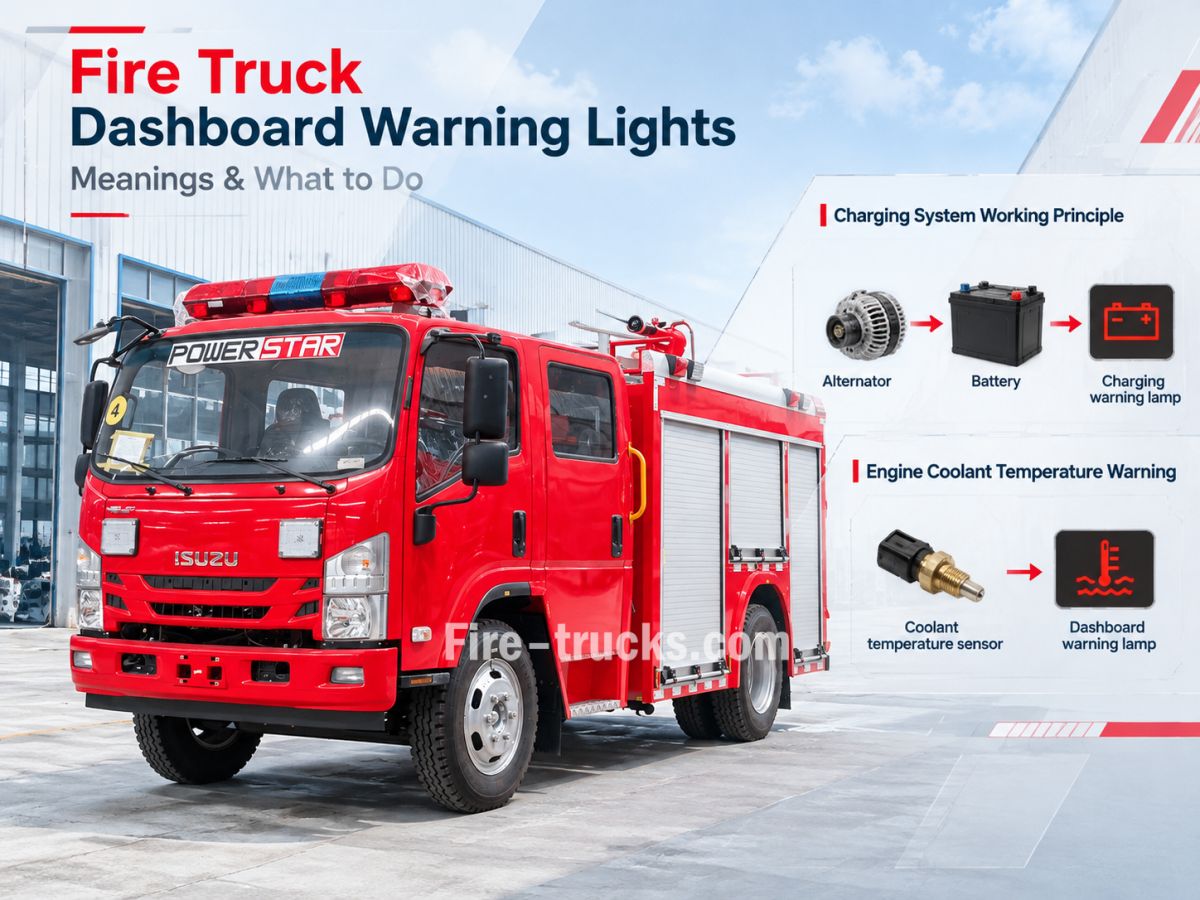
When a fire truck starts, numerous warning lights illuminate in the center of the dashboard and then automatically turn off after a few seconds. This process is the vehicle's self-check system. To help drivers fully master the overall condition of a fire truck, it is essential to understand these instruments and use them to judge whether each component is working normally. Common indicator lights typically include door ajar, parking brake, seatbelt, engine self-check, oil pressure, ABS, airbag, battery, and fuel level. This article explains how to read the main fire truck gauges and warning lights—including the gauges on the dedicated fire pump operation panel—and outlines preventative measures to maintain vehicle safety and operational readiness. ♦ I. Understanding Fire Truck Gauges Gauges provide continuous readings of engine and system conditions. Unlike warning lights, which only activate when a threshold is crossed, gauges allow the driver to monitor trends and detect problems before they become critical. A fire truck has two main areas for monitoring: the chassis dashboard and the fire pump operation panel. 1. Chassis Dashboard Gauges Oil Pressure GaugeThe oil pressure gauge displays the pressure in the engine's main oil gallery while the engine is running, indicating whether the lubrication system is working properly. On imported fire trucks, the oil pressure gauge is often marked "OIL."Oil pressure is determined by engine speed. Preventative measure: If the pointer drops to "0" or rises above the normal pressure range, the engine should be shut down immediately to investigate the cause. Continuing to run an engine with low oil pressure can cause severe internal damage. Water Temperature GaugeThe water temperature gauge shows the temperature of the engine coolant. The starting temperature must exceed 50°C. When the temperature is below 50°C, avoid high-speed or heavy-load operation.Normal operating temperature should be maintained between 80°C and 95°C. The gauge is marked with "H" (hot) and "C" (cold). A pointer toward "H" indicates overheating; a pointer toward "C" indicates the engine is too cold; a pointer between the two indicates normal temperature. Preventative measure: If the gauge reads 100°C while driving, the engine should be idled immediately, and the cooling system or coolant level should be checked. Add coolant if necessary. Engine Coolant Circulation Schematic Engine TachometerThe tachometer displays engine speed in revolutions per minute (RPM). It is used when adjusting idle speed and when checking the engine speed for maximum fire pump efficiency. The tachometer has a red warning line. When the speed reaches the red zone, reduce throttle or shift gears to lower engine RPM. Preventative measure: During pump operations, never exceed the maximum RPM specified in the manufacturer's manual. Overspeeding the engine can damage the pump and engine compo...
Details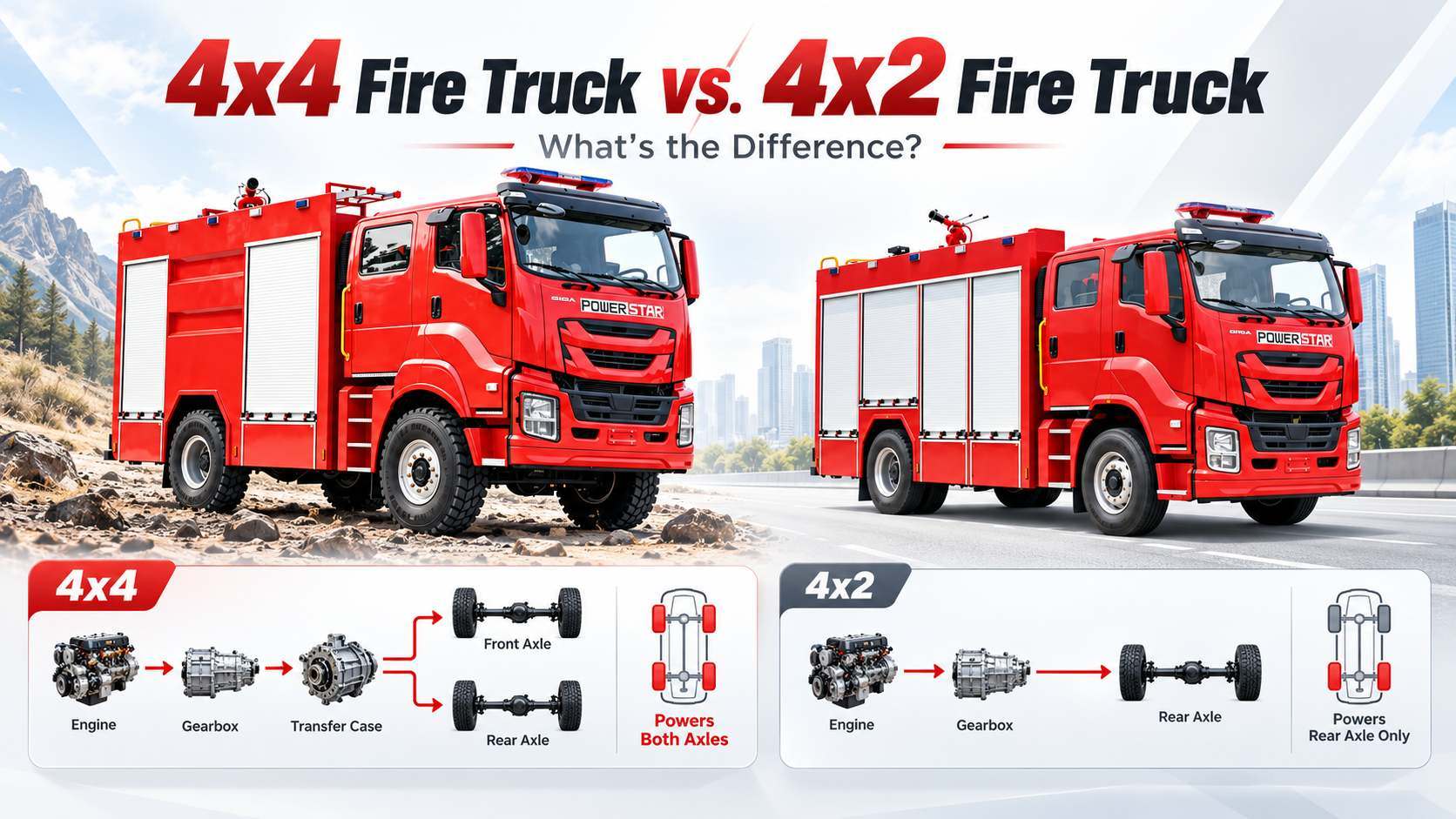
When specifying a fire truck, one of the first chassis decisions is the drive configuration. A 4×2 fire truck drives through two wheels on a single axle, while a 4×4 fire truck delivers power to all four wheels. That difference may sound simple, but it changes where the truck can go, how much it costs, and what kind of fire scenarios it can handle. This guide explains the practical differences between 4×4 and 4×2 fire trucks, the trade-offs involved, and how to choose the right configuration for your operational requirements. Quick Answer A 4×2 fire truck uses two-wheel drive, typically on the rear axle. It is lighter, less expensive, and more maneuverable on paved roads, making it the standard choice for urban and municipal firefighting. A 4×4 fire truck delivers power to all four wheels, providing superior traction on unpaved roads, mud, snow, and steep terrain. It is heavier, more expensive, and less fuel-efficient, but it is essential for wildland, rural, and off-road response. I. How the Two Configurations Work 4×2 configuration: The engine sends power to a single rear axle. The front wheels steer but do not drive. This is the conventional layout for commercial trucks and most municipal fire apparatus. It is simple, proven, and efficient on hard surfaces. 4×4 configuration: The engine sends power to both the front and rear axles through a transfer case. The driver can engage or disengage the front axle as needed. When engaged, all four wheels pull the vehicle forward, dramatically improving traction on loose or slippery surfaces. II. Key Differences at a Glance Comparison Item 4x2 Fire Truck 4x4 Fire Truck Drive wheels Rear axle only Front and rear axles Traction on loose surfaces Limited Excellent Off-road capability Paved roads and firm ground Mud, snow, sand, steep slopes, unpaved roads Vehicle weight Lighter Heavier (transfer case, front drive axle) Purchase cost Lower Higher Fuel efficiency Better Lower Maintenance complexity Lower Higher (additional driveline components) Ground clearance Standard Typically higher Turning radius Often tighter Often larger Center of gravity Lower Higher Best suited for Urban streets, municipal response Wildland, rural, rugged terrain III. Where 4×2 Excels: Urban and Municipal Firefighting A 4×2 chassis is the standard for most municipal fire apparatus, and for good reason. Lower cost and weight: A 4×2 chassis costs less to purchase and maintain. It is also lighter, which allows a larger water tank or more equipment within the same gross vehicle weight rating. One fire department analysis found that choosing a 4×2 configuration allowed them to fit a 1,500-gallon tank instead of a 500-gallon tank—a threefold increase in water capacity—while also lowering the overall cost . Better maneuverability on paved roads: A 4×2 truck typically has a tighter turning radius...
Details
A foam fire truck is a specialized firefighting vehicle designed to transport, mix, and discharge water and foam extinguishing agents for efficient fire suppression. Unlike standard fire trucks that rely primarily on water, foam fire trucks are equipped with a dedicated foam system that mixes water and foam concentrate at a preset ratio to form foam solution. A foam fire truck can discharge water and foam solution simultaneously or independently, making it particularly suitable for extinguishing oil fires (Class B fires). This article provides a systematic explanation of the foam fire truck from the perspectives of engineering structure, power transmission, proportioning principle, operational procedures, and daily maintenance. Quick Answer A foam fire truck consists of a chassis and an upper superstructure. Its working principle is: the chassis engine outputs power through the power take-off (PTO), which drives the fire pump via a drive shaft. The fire pump pressurizes water, and the foam proportioning system draws foam concentrate at a preset ratio (typically 3% or 6%) to form foam solution, which is finally discharged through the fire monitor or foam nozzle for firefighting. I. Overall Structure of a Foam Fire Truck A foam fire truck generally consists of two main parts: the chassis and the firefighting superstructure. The upper superstructure mainly includes the following core components: Power Take-Off (PTO): Transfers engine power from the chassis drivetrain to the fire pump Water Tank: Stores plain water for straight stream discharge and foam solution preparation Foam Tank: Stores foam concentrate Equipment Compartment: Stores hoses, nozzles, tools, and couplings Fire Pump: Draws water, pressurizes it, and delivers water or foam solution Priming Pump: For drafting water (e.g., piston priming pump) Foam Proportioning System: Mixes foam concentrate with water at the required ratio Fire Monitor: Manual or remote-controlled long-range discharge device II. Power Output System (PTO) The power source of a foam fire truck is the chassis engine. The PTO extracts power from the gearbox or engine flywheel and transmits it to the fire pump through a drive shaft. Medium and heavy foam fire trucks currently mostly use full-power sandwich-type PTOs (front of gearbox) or drive shaft PTOs (rear of gearbox). The PTO output drives the fire pump. The fire pump draws water from the tank or an external source and pressurizes it. Part of the pressurized water from the fire pump enters the foam proportioning system, while the other part is used directly for firefighting. The foam proportioning system draws foam concentrate from the foam tank and mixes it with water at the preset ratio to form foam solution, which is finally delivered to the fire monitor or foam nozzle for discharge. III. Foam Proportioning System 1. Structure The foam proportioner is installed on the fire pump piping. Its main structure includes the dischar...
Details
A fire monitor—also called a fire truck water cannon or vehicle-mounted monitor—is a core component of modern fire truck apparatus. It discharges high-volume water streams or firefighting foam, helping firefighters suppress fires in high-rise buildings, industrial facilities, and other areas that are difficult to approach directly or present significant safety risks. But choosing the right fire monitor is not simply a matter of picking the model with the longest range or the highest flow rate. Should your fire truck use a manual, electric, or remote-control monitor? How much flow do you actually need? What is the difference between common models like PL8/24, PL8/32, and PL8/48? This article explains the key selection factors and compares three common foam-water fire monitors to help fire departments, apparatus manufacturers, and equipment buyers make informed decisions. Quick Answer Manual fire monitors are operated on-site by handwheel or handle—simple, reliable, and low-cost, suited for attended positions with moderate fire risk. Electric fire monitors use motor-driven actuators controlled from the cab or a wired panel—they keep operators away from heat and smoke. Remote-control fire monitors add wireless operation, preset positions, and automatic detection integration—essential for high-risk, access-prohibited zones. I. Fire Monitor Control Types: Manual vs. Electric vs. Remote 1. Manual Fire Monitor A manual fire monitor relies on a handle, lever, or handwheel to achieve horizontal rotation and vertical elevation. Its structure is simple, and it is widely used on conventional fire trucks. Key characteristics: Simple operation and mechanical structure Operates in power-outage conditions or remote areas Lower purchase and maintenance cost Suitable for fire trucks where the monitor position is easily accessible When to choose: Small to medium warehouses, docks, pump stations, and other attended positions where fire risk is moderate and personnel access is safe. Limitation: The manual monitor has a single point of failure—someone must be at the monitor position. If the area is too dangerous to approach, the monitor cannot be operated. 2. Electric Fire Monitor An electric fire monitor uses motor-driven mechanisms for horizontal and vertical movement. Operators typically adjust the monitor through a wired joystick, control panel, or integrated vehicle control system. Key characteristics: Motor-driven adjustment with faster response and higher precision Operator stays in the cab or at a safe distance Easy integration with vehicle control systems Some models support preset positions and automatic oscillating spray When to choose: Medium to large industrial facilities, chemical plants, and locations where manual operation would expose personnel to heat, smoke, or toxic fumes. Limitations: Requires a dedicated power supply More complex installation and wiring Motors and control...
Details
The top of a fire truck water tank is not a flat cover—it is a working platform that integrates filling, ventilation, overflow protection, firefighting equipment, and crew safety. Every component mounted on the fire truck tank top serves a specific function during water supply and firefighting operations. Understanding this fire truck layout is essential for apparatus specifiers, pump operators, and maintenance personnel. This article explains the complete top structure of a fire truck water tank, covering the manhole, overflow area, safety rail, fire monitor, hose storage, and other key components. Quick Answer The top structure of a fire truck water tank typically includes: a manhole for internal inspection and cleaning, an overflow area to prevent over-pressurization during filling, a safety rail for crew protection during roof access, a fire monitor for elevated water or foam discharge, hose storage for quick deployment, and a filling connection for tank filling. Each component is positioned to support efficient water supply and safe operation. I. Fire Truck Water Tank Manhole: Primary Inspection and Cleaning Access The manhole is the primary access point for internal tank inspection, cleaning, and maintenance. It is typically a circular opening with a sealed cover, located on the tank top for easy access from the vehicle roof. Key features: • DN500mm standard opening — large enough for personnel entry• Sealed cover with gasket to prevent water leakage and contamination• Hinged or removable design for convenient opening and closing• Locking mechanism to secure the cover during vehicle operation Function: The manhole allows operators to inspect the tank interior for corrosion, sediment buildup, and baffle condition. It also provides access for cleaning and repair. During filling, the manhole can serve as an emergency vent if the normal venting system is blocked. Maintenance note: The manhole gasket should be inspected regularly for aging, cracking, or deformation. A damaged gasket can cause water leakage and allow contaminants to enter the tank. II. Overflow Area: Protection Against Over-Pressurization The overflow area controls the discharge of excess water after the tank reaches full capacity, preventing over-pressurization and tank structural damage. Key features: • Overflow pipe with a diameter sufficient to handle the maximum filling rate• Positioned at the highest point of the tank to ensure complete filling before overflow• Screened or covered to prevent debris and insects from entering• Drainage path directed away from the vehicle body and electrical components Function: During hydrant filling or pump filling, the overflow area prevents water from building up excessive pressure inside the tank. If the tank is overfilled, exce...
Details
Fire truck tank baffles work on the principles of slosh suppression and energy dissipation in fluid mechanics. When a fire truck accelerates, brakes, or turns during driving, the water inside the tank generates severe sloshing forces. By installing perforated partitions inside the tank, baffles divide the large water volume into multiple smaller compartments. The orifice throttling effect dissipates the sloshing kinetic energy, while the rigid support of the partitions strengthens the structural stability of the tank. The structural design and working principle of fire truck tank baffles are a key concern for many customers, especially their impact on driving safety and tank service life. Let's take a closer look today. I. Three Core Functions of Fire Truck Tank Baffles 1. Suppress liquid sloshing: Divide the water inside the tank into multiple independent compartments, limiting the free flow range of water in both longitudinal and transverse directions, and reducing sloshing amplitude. 2. Reduce center of gravity shift: Dissipate sloshing kinetic energy through orifice throttling, slowing the severe shift of the water's center of gravity caused by vehicle movement, and reducing rollover risk. 3. Enhance tank stiffness: Baffles are welded to the tank walls, forming an internal reinforcing structure that improves the tank's resistance to water pressure deformation and mechanical impact. II. Working Principle of Fire Truck Tank Baffles 1. Fluid Segmentation and Compartmentalization Design Segmentation principle: Baffles are arranged longitudinally along the tank, typically at fixed intervals, dividing the internal space into multiple relatively independent compartments. Water flow between compartments must pass through the orifices on the baffles, significantly restricting the flow path. Spacing design: Baffle spacing is typically determined by tank length and water capacity. Excessive spacing results in insufficient slosh suppression; spacing that is too small increases tank weight and reduces effective volume. Reasonable spacing design requires a balance between suppression effectiveness and lightweight construction. 2. Orifice Throttling and Damping Effect Throttling principle: When water flows through the baffle orifices during sloshing, the flow cross-section suddenly narrows, velocity increases, and local resistance loss occurs. Friction and collision between water molecules and between water and orifice edges convert sloshing kinetic energy into heat and dissipate it. Damping effect: Smaller orifices provide stronger throttling and damping, resulting in better slosh suppression, but also greater resistance to water flow, which may affect filling and discharge speed. Therefore, orifice size must be determined based on actual operational requirements. 3. Structural Reinforcement Welded connection: Baffles are welded to the tank inner walls around their perimeter, forming rigid support. When the tank is s...
Details
Please subscribe latest fire trucks news, and Warmly welcome to tell us what you think.

 IPv6 network supported
Links :
ISUZU Trucks
CEEC Trucks
CS Trucks

 English
 français
 Deutsch
 русский
 italiano
 español
 português
 Nederlands
 العربية
 日本語
 한국의
 Türkçe
 Melayu
 ไทย
 Tiếng Việt
 Indonesia
 中文
 қазақ
 Filipino
 မြန်မာ
 српски